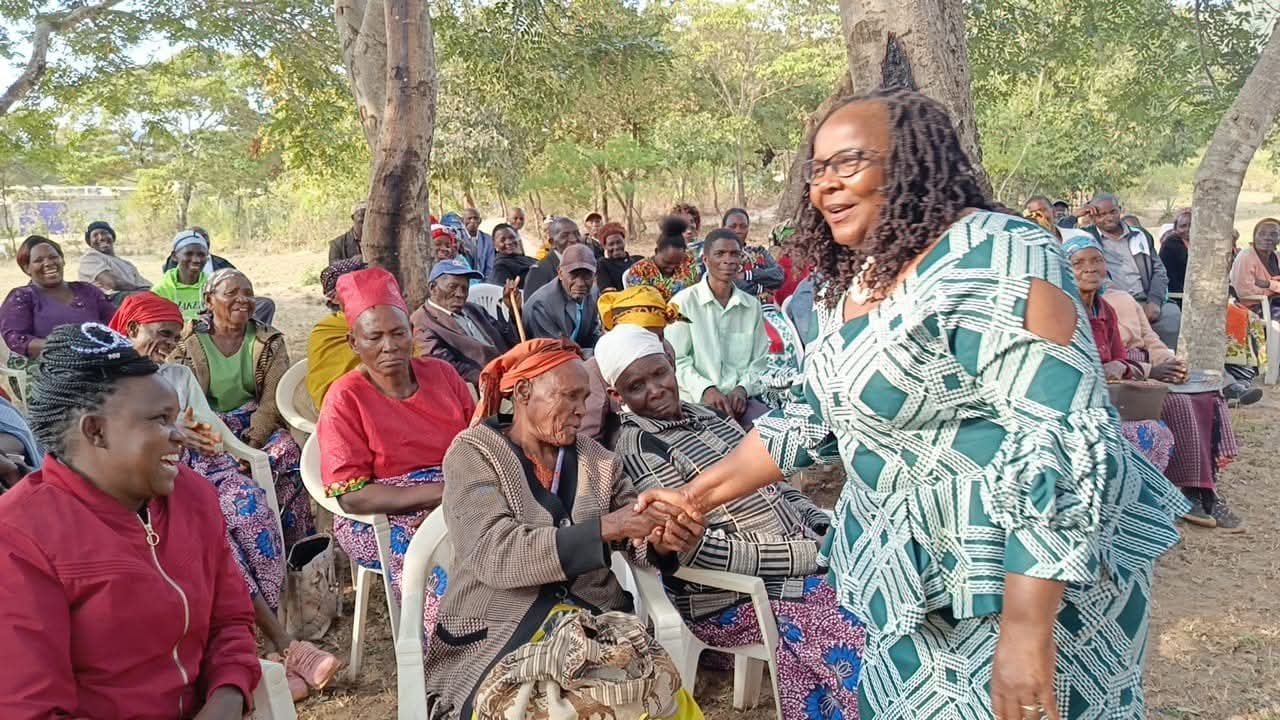
 Makueni Member of Parliament, Susan Ndunge Kiamba during a bursary issuance exercise in Kitise/Kithuki Ward, Makueni County on February 17, 2026. Photo by Andrew Mbuva.


By Andrew Mbuva.
Makueni Member of Parliament, Susan Ndunge Kiamba, has strongly criticised the implementation of the Nyota youth empowerment project, calling for transparency and accountability in the management of the World Bank-funded initiative.
Speaking during a bursary issuance exercise in Kitise/Kithuki Ward, Makueni County, Kiamba expressed disappointment over what she termed as poor implementation of the programme, which is intended to economically empower young people across the country.
The legislator demanded that the ministry in charge of the project provide ward leaders with a comprehensive list of beneficiaries to enable proper monitoring and support for the youth who have received funding.
Kiamba questioned the cost-effectiveness of the project, claiming that large sums of money are being spent on administrative and logistical arrangements, with minimal impact reaching intended beneficiaries.
“This is a loan from the World Bank that Kenyan citizens will ultimately repay. There must be full accountability. We cannot pay for funds that we have not seen translate into tangible benefits for our people,” she said.
The MP further raised concerns over the allocation and utilisation of funds, questioning how large groups are mobilised at high costs only to disburse comparatively smaller amounts that are not visibly transforming livelihoods on the ground.
She urged the responsible ministry to clearly outline how the funds are distributed, who the beneficiaries are, and the measurable outcomes of the project.
Kiamba also criticised the handling of student placement and reporting for Grade 10, faulting the Ministry of Education for what she described as poor planning and lack of clear capacity guidelines for schools.
She noted that some national schools have become severely overcrowded, while several county schools remain underutilised despite having qualified staff deployed by the Teachers Service Commission.
The MP emphasised that school capacity should not only be determined by physical infrastructure such as classrooms but also by the availability of teachers, emotional well-being of learners, and quality teacher-student engagement.
“We have schools with thousands of students beyond manageable levels, yet others have no learners despite having teachers and infrastructure. That reflects a failure in planning and regulation,” she stated.
Kiamba urged education authorities to urgently review placement policies and implement structured guidelines to ensure equitable distribution of learners across schools.
She further warned against wastage of public resources, arguing that taxpayer money should be matched with efficient service delivery and proper planning within the education sector.
The MP challenged relevant government agencies to take responsibility for policy failures and ensure that competent leadership is placed in critical sectors to safeguard the country’s education standards and development programmes.
“We cannot run a country like a kiosk. Kenya has capable professionals who can deliver results. Where there is failure, corrective measures must be taken to ensure our education system and development projects serve wananchi effectively,” she said.
Kiamba reiterated her commitment to pushing for accountability and improved service delivery, stating that public resources must always benefit citizens and not be lost through inefficiencies or poor planning.