
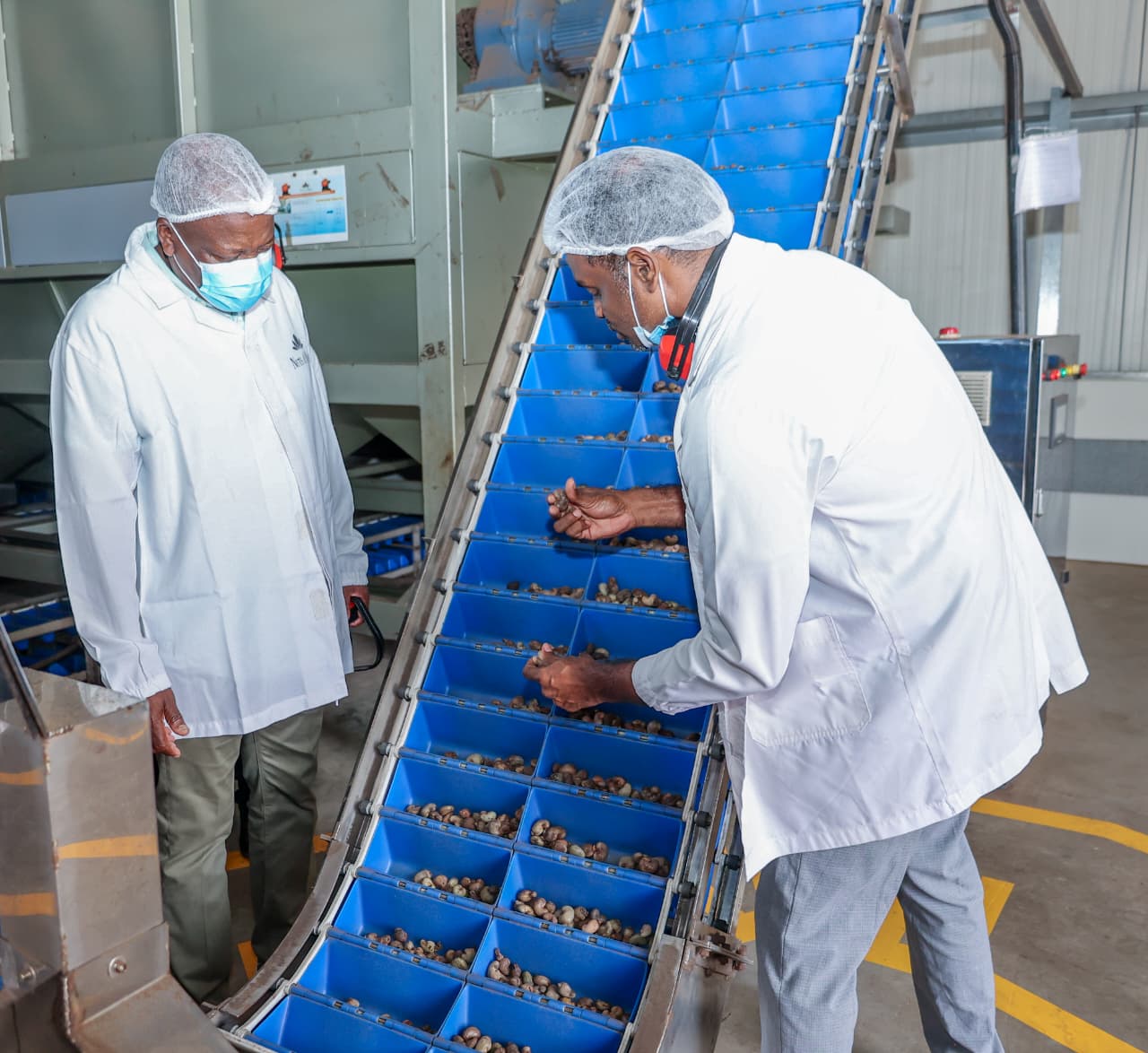
 Agriculture Cabinet Secretary Mutahi Kagwe ( left) during a visit to cashew farmers and processors in Kilifi County on January 8, 2026. Photo Courtesy.


By Andrew Mbuva
Agriculture Cabinet Secretary Mutahi Kagwe has launched an ambitious push to revive Kenya’s struggling cashew nut industry, warning that years of declining production have robbed the economy of jobs, incomes and export earnings, even as global demand for the crop continues to rise.
Kenya currently produces about 13,000 tonnes of cashew nuts annually—far below its installed processing capacity of 45,000 tonnes. Kagwe said the wide gap has forced processors to operate below capacity, driven farmers out of the crop and denied the economy hundreds of thousands of potential jobs, particularly along the Coast where cashew once anchored livelihoods.
According to the Agriculture and Food Authority (AFA), a fully revived cashew industry could create up to 350,000 jobs across farming, processing, transport and exports, contribute more than Sh30 billion to GDP, and restore the crop as a major income earner for coastal communities.
Speaking during a visit to cashew farmers and processors in Kilifi County, Kagwe said the decline is not due to lack of potential but weak production systems, low adoption of improved varieties and underutilised research. He was accompanied by AFA Director General Dr Bruno Linyiru and Ann Gikonyo, Director of Nuts and Oil Crops at AFA.
The CS said the revival strategy is anchored on science-led solutions and farmer support, spearheaded by the Kenya Agricultural and Livestock Research Organisation (KALRO), particularly its Mtwapa Centre, which focuses exclusively on cashew research.
He revealed that KALRO has developed a new disease-tolerant cashew variety capable of doubling yields, with 20,000 seedlings ready for distribution during the coming long rains. Four additional improved varieties are at advanced stages of development and will be released within six months.
“Farmers have complained about declining yields and disease pressure. Research has responded, and the solutions are ready,” Kagwe said.
Seedling multiplication and distribution will be coordinated by AFA in collaboration with county governments, with support from KEPHIS and extension services to ensure quality and effective delivery to farmers.
The ministry also intensified farmer sensitisation on good agronomic practices, including recommended spacing of 10 metres by 10 metres and intercropping cashew with coconut and mango to boost incomes and climate resilience. KALRO officials noted that top-grafting offers a faster option for rehabilitating ageing orchards.
Kagwe questioned Kenya’s reliance on imports despite strong local potential. “How can we be importing cashew nuts when our land is idle and our farmers are struggling?” he posed.
Processors told the CS that insufficient raw cashew supply remains the biggest constraint. East River Foods EPZ Ltd said it has invested about USD 3 million in the value chain, employs 600 women and works with 15,000 farmers, but low farm-level production continues to limit operations.
Kagwe said reviving the sector will require a whole-of-government approach and announced plans for a high-level stakeholder meeting to fast-track a master plan to restore production, stabilise supply and rebuild farmer confidence.
“Cashew farmers, there is hope. We have heard you, and this time we are moving with speed and seriousness,” he said.