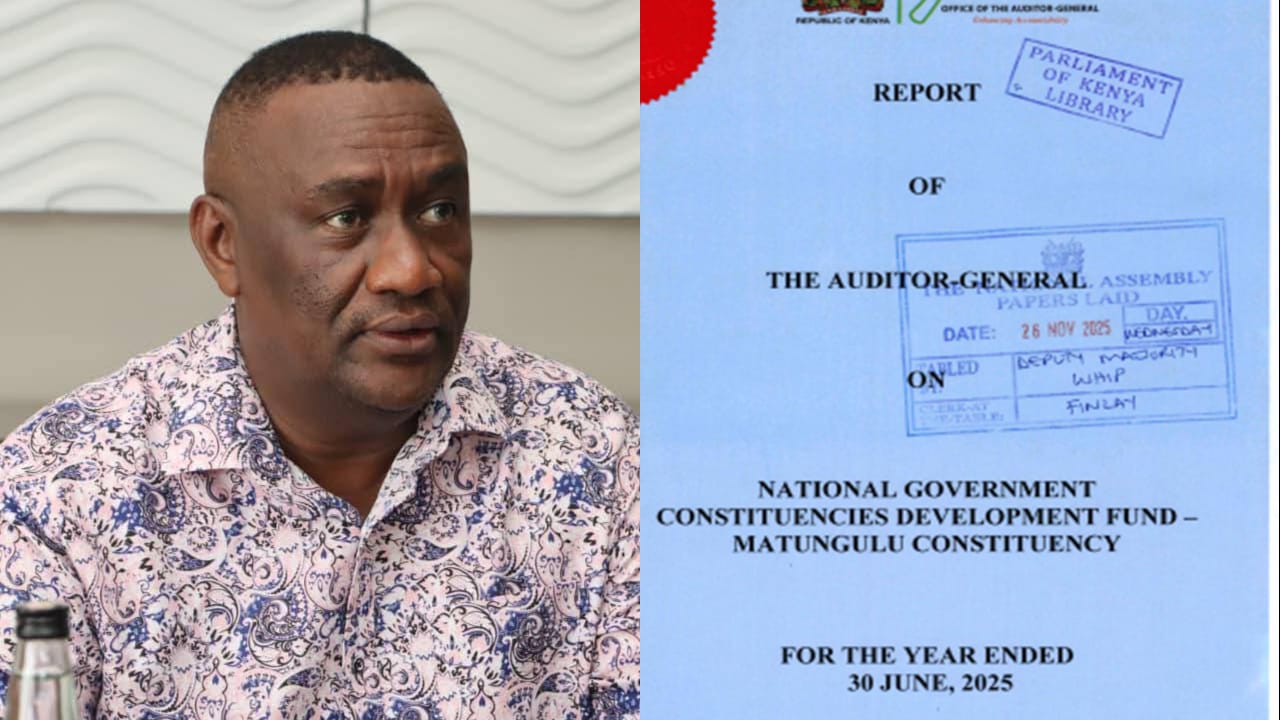
 Matungulu MP Stephen Mutinda Mule.


By Our Reporter.
Millions of shillings meant to uplift education, protect the environment, and improve livelihoods in Matungulu Constituency may have been squandered through stalled projects, procurement breaches, and weak oversight, according to a damning audit by the Auditor-General for the year ended June 30, 2025.
While the financial statements of the Matungulu National Government Constituencies Development Fund (NG-CDF) received a clean audit opinion, the Auditor-General’s report lifts the lid on a troubling pattern of unfinished projects, unexplained deviations, and public funds lying idle, raising serious questions about accountability and value for money.
At Tala Girls Secondary School, Kshs.8 million was released for a multipurpose hall. On paper, the project was progressing. On the ground, auditors found a different story.
Nearly seven months after the expected completion date, the structure remained incomplete. Electrical works were missing, while the floor finishing deviated from the approved design — terrazzo tiles had replaced the non-slip ceramic tiles specified in the Bill of Quantities. Crucially, no approval was provided to justify the change, effectively turning a publicly funded project into an undocumented variation riddled with red flags.
At Fr. Heeran Girls High School, Kshs.4 million was disbursed for a storey library. The contract deadline lapsed, yet the building was still unfinished. Auditors found no evidence that the contractor was granted an extension, exposing glaring weaknesses in contract management and supervision.
The situation was even more alarming at AIC Katwanyaa Secondary School, where over Kshs.11.5 million was released for a tuition block. The contractor abandoned the site after receiving Kshs.8.3 million, citing financial difficulties. Two years later, the project remains stalled, with no proof that the tender was re-advertised or that recovery measures were taken.
“In these circumstances, value for money could not be confirmed,” the Auditor-General stated — a phrase that often precedes deeper investigations.
Funds meant to fight climate change have not been spared either. The audit revealed that Kshs.1.9 million was spent on tree planting in schools, with each institution expected to receive 500 seedlings. However, site visits exposed a stark contradiction: some schools received as few as 50 seedlings.
Worse still, delivery notes, distribution lists, and supporting documentation were missing, leaving auditors unable to verify where the remaining seedlings — and money — went.
In a country battling climate shocks, the audit raises an uncomfortable question: Was environmental protection reduced to paperwork and photo opportunities?
Perhaps the most direct violation of the law involved unutilized Project Management Committee (PMC) funds. The audit uncovered Kshs.1.27 million sitting idle in PMC bank accounts with no movement throughout the year — a strong indication that projects had either stalled or been completed. Yet the funds were never returned to the constituency account, as required under Section 12(8) of the NG-CDF Act.
Management failed to provide bank balance certificates, placing the constituency in clear breach of the law and exposing the risk of silent fund diversion.
Despite having ambitious development plans, Matungulu NG-CDF suffered a double blow: under-funding and under-spending. Out of an approved budget of Kshs.332 million, only Kshs.281 million was received. Even then, just Kshs.203 million was spent, leaving over Kshs.77 million unused.
The Auditor-General warned that this under-absorption undermined project implementation and compromised service delivery, meaning communities paid the price for bureaucratic inertia and weak execution.
Although the audit confirmed that internal controls and governance structures exist on paper, the findings paint a starkly different reality on the ground — one where oversight fails, contractors walk away unpunished, and millions of shillings remain unaccounted for.
As public pressure mounts, residents of Matungulu are now demanding answers:
Who approved undocumented project changes? Why were stalled projects left to rot? And when will idle public funds be recovered?