
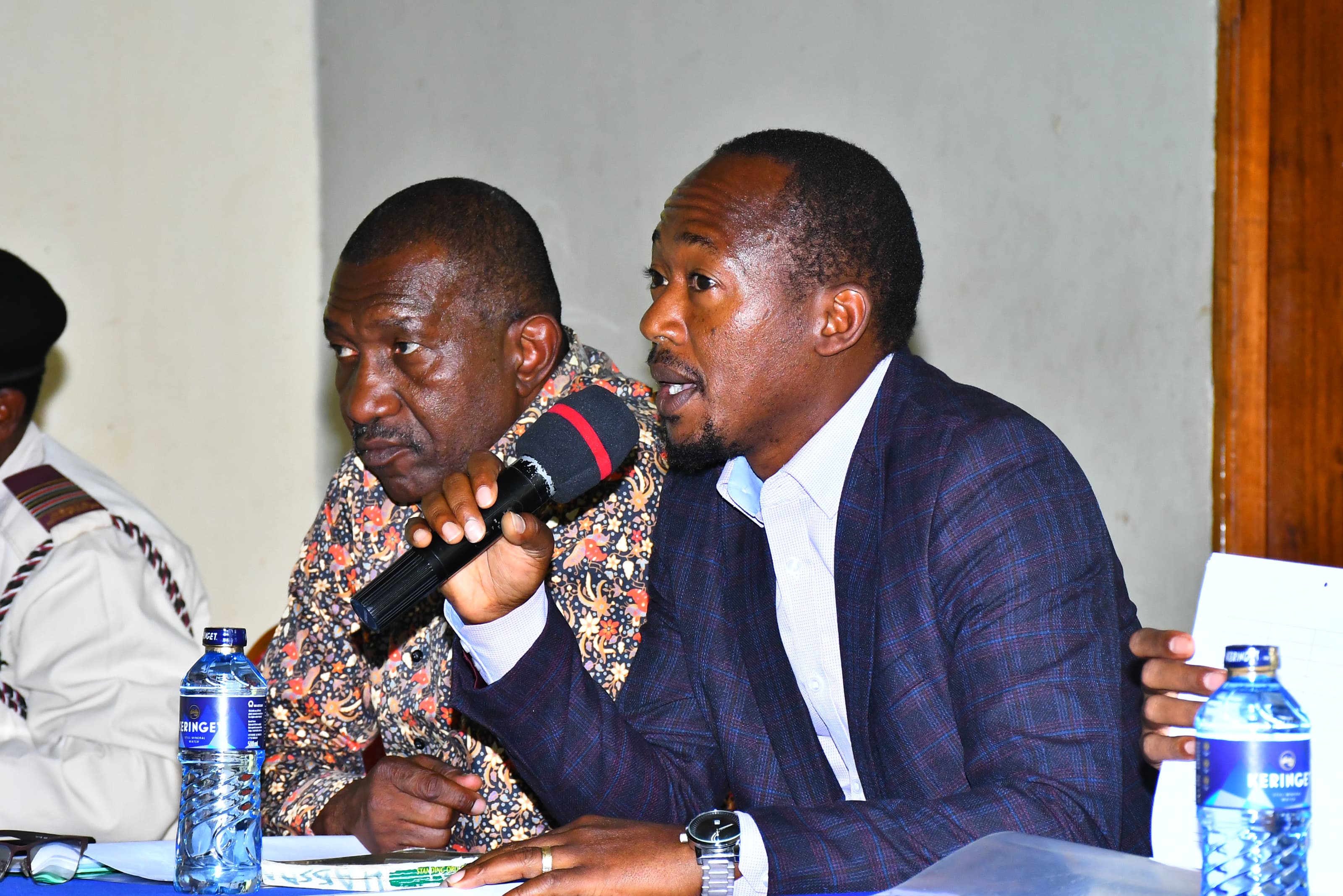
 Mwala MP Vincent Musyoka, Chair of the National Assembly Committee on Environment, Forestry and Mining leading a Public Participation exercise on the Forest Conservation and Management (Amendment) Bill, 2025 at Wote Green Park, Makueni on April 22, 2026. Photo by Komu Musango.


By Andrew Mbuva.
Residents living near forests could soon take on a more active role in conservation—and directly benefit from it—under proposed amendments to Kenya’s forest laws.
This was revealed during a public participation forum held at Wote Green Park in Makueni County, where Mwala MP Vincent Musyoka, Chair of the National Assembly Committee on Environment, Forestry and Mining, addressed the media after engaging residents on the Forest Conservation and Management (Amendment) Bill, 2025.
Musyoka said the proposed changes aim to seal gaps in the existing Forest Conservation and Management Act while aligning it with emerging environmental realities and newer frameworks such as the Climate Change Act. He emphasized that law-making is a continuous process shaped by evolving challenges, particularly in environmental conservation.
Central to the proposed amendments is a shift toward community-centered forest management. The committee is proposing a structured framework that would allow communities living adjacent to public forests to formally partner with the government in planting and nurturing trees.
Under this model, communities would be entitled to a share of the revenue generated when the trees mature and are harvested, effectively turning conservation into an economic opportunity. Musyoka noted that vast tracts of government forest land remain idle, particularly in arid and semi-arid regions, yet they hold significant potential if communities are empowered through such partnerships.
The proposed law also seeks to address long-standing neglect of dryland forestry by expanding afforestation efforts beyond traditionally high-rainfall areas. Musyoka pointed out that regions like Ukambani have often been overlooked due to harsh climatic conditions, but with the right tree species and technical support, they can contribute significantly to the country’s forest cover.
He added that private forest owners would also benefit from the amendments, as current legislation largely focuses on public forests. Institutions such as the Kenya Forestry Research Institute are expected to play a greater role by decentralizing research and making it accessible to local communities.
At the same time, the Bill proposes tougher penalties for illegal logging and destruction of forests. Musyoka criticized the current legal framework for imposing relatively low fines that fail to match the scale of profits made through illegal activities. He argued that stronger punitive measures are necessary to safeguard public resources and deter offenders who exploit weaknesses in existing laws, particularly in timber harvesting and transportation.
The issue of encroachment into protected areas, especially riparian zones, also featured prominently in the discussions. Musyoka expressed concern over the worsening state of major rivers such as the Athi River and the Nairobi River, attributing the pollution largely to human settlements along riverbanks. He stressed the need for clear demarcation and strict enforcement to prevent habitation and dumping of waste in these sensitive areas, warning that failure to act would continue to degrade critical water sources.
Beyond enforcement, the proposed amendments seek to transform how tree planting initiatives are conducted in the country. Musyoka noted that limiting activities to an annual tree-planting week has proven ineffective, and the new framework would empower the Environment Cabinet Secretary to designate multiple tree-planting days throughout the year. This, he said, would encourage continuous engagement and help accelerate efforts toward increasing national tree cover.
The Makueni forum is part of a nationwide public participation exercise, with similar engagements taking place across different counties. The committee is collecting views from wananchi to refine the Bill before it is presented in Parliament. If enacted, the amendments are expected to significantly reshape forest management in Kenya by placing communities at the heart of conservation while ensuring they share in the economic benefits of protecting the country’s natural resources.