
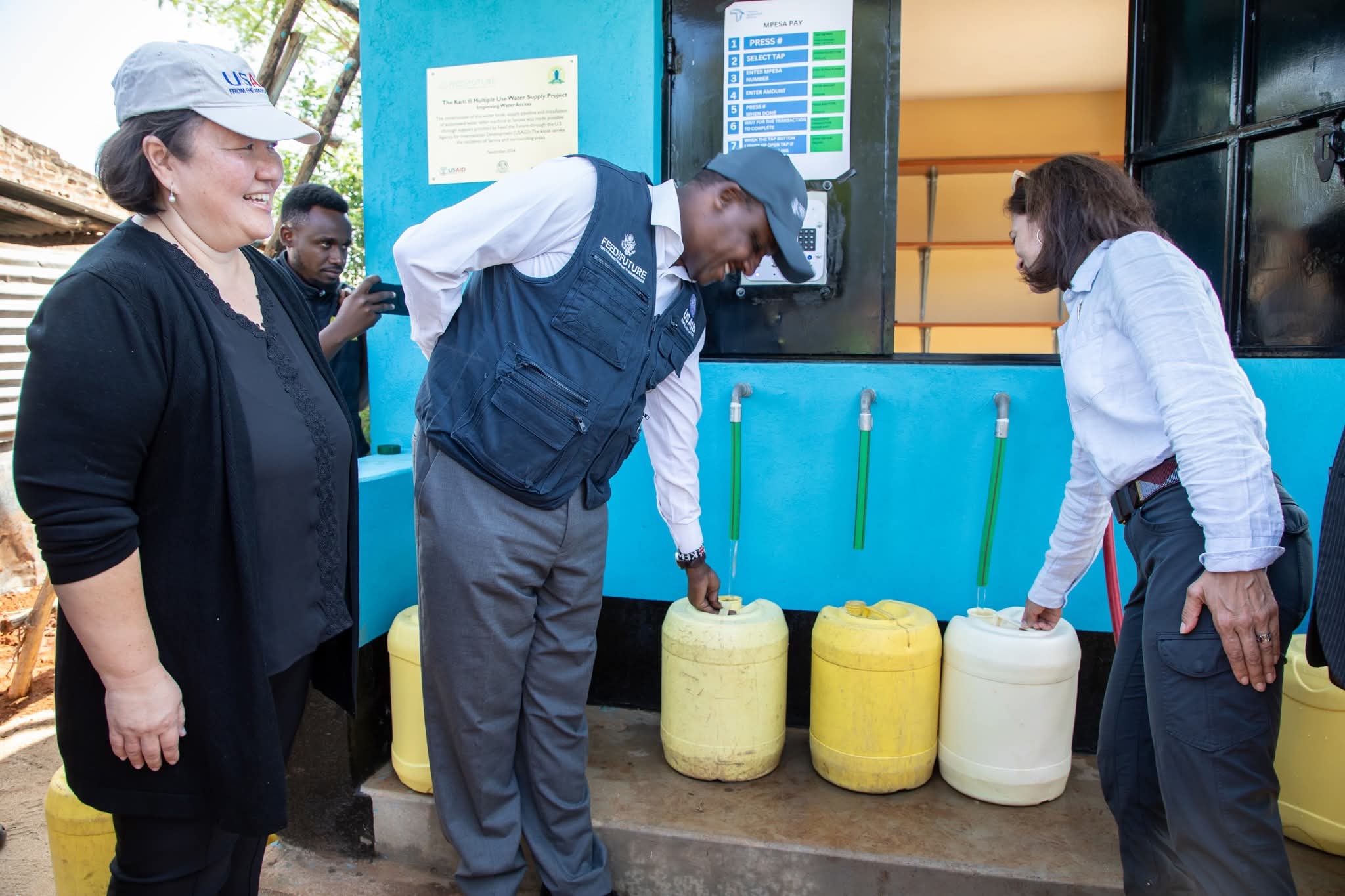
 Governor Mutula Kilonzo Jr on December 3, 2024 hosted USAID Deputy Assistant Administrator for Resilience, Environment and Food Security Mia Beers for a tour of the Kaiti 2 project implemented through Collaboration with USAID-STAWI and Makueni County under the FLLoCA programme. Photo by Gvrns Press.


By Andrew Mbuva
A social audit conducted on several climate-related water projects in Makueni County has revealed notable progress in improving community access to water, while also highlighting governance, sustainability and transparency challenges that need urgent attention.
The audit, carried out by the Makueni Development Trust (MADET) with support by VSO Kenya through the ACTIVE Citizenship Through Volunteering and Empowerment (ACTIVE) project from the World Bank-funded climate change programme, was presented during a multi-stakeholder interface meeting held at Kelvian Hotel. The forum brought together county government officials, community members, Water Community Climate Project Committees (WCCPCs), and project management representatives to review the findings and validate the results.
Speaking during the meeting, MADET representative Robert Muli said the exercise focused on four climate resilience projects including the Kinze Water Project, Ukia Water Project, Isuuni Water Project, and Kaiti II Water Project.
According to Muli, the meeting provided an opportunity for stakeholders to openly discuss what has worked well and identify gaps that require improvement as the county prepares for the next phase of the climate programme.
“We brought together government officials and community stakeholders to share and validate the findings from the social audit. The goal is to strengthen accountability and improve how these projects serve local communities,” he said.
The audit found that several of the projects have made significant contributions to improving water access and supporting climate resilience efforts in the county.
In particular, the Ukia Water Project was highlighted as a success story, with residents already benefiting from improved water supply. The project’s demonstration farm has also begun delivering the intended agricultural results envisioned during the project’s inception.
Similarly, the Kinze Water Project has enhanced water availability and created livelihood opportunities for residents through complementary initiatives such as aquaculture.
The projects were largely designed to promote locally led climate solutions, enabling communities to respond to water scarcity and climate variability.
Despite the achievements, the audit uncovered several challenges affecting project sustainability.
For the Kinze Water Project, issues identified included limited access to project information, weak management after project handover, inconsistent operation of water kiosks, and illegal water connections that reduce water pressure for legitimate users.
The project also faces environmental and safety risks, including illegal fishing activities affecting aquaculture efforts and lack of fencing around the dam and solar installations.
“These gaps reduce community accountability and could affect the long-term sustainability of the project if not addressed,” Muli noted.
The audit also revealed governance and transparency gaps in the Kaiti II Water Project.
Community members reported limited access to key project documents such as work plans, contracts and total project costs. In addition, many residents were unaware of existing grievance mechanisms for reporting complaints.
There were also allegations of political interference in water distribution patterns, management of demonstration farms and the composition of Project Management Committees (PMCs). According to the report, such interference has created tension and discouraged community participation.
The audit further highlighted concerns about equitable water distribution.
Residents claimed that Wote town receives a larger share of water, while areas such as Sarova and Kaseve experience rationing. Farmers also expressed concern that the introduction of water billing has made irrigation water less affordable.
Climate-related risks were also identified, including vulnerability of the river source to drying or flooding, as well as technical limitations of the solar pumping system, which cannot operate at night.
Land ownership disputes could also emerge in future because some land used for project infrastructure was donated by household heads without full consent from extended family members.
Another concern raised during the audit was the declining level of community engagement after project handover.
Public barazas often recorded low attendance, partly due to long travel distances and lack of facilitation for participants. Persons with disabilities were also rarely represented in meetings, while most PMC members were elderly, limiting diversity and youth participation.
To address the challenges, the audit recommends a number of immediate and long-term interventions.
These include public disclosure of Bills of Quantities (BoQs), contracts and expenditures to enhance transparency, as well as the development of a formal sustainability plan to guide long-term project management.
Other recommendations include strengthening the capacity of Project Management Committees, introducing subsidy mechanisms for irrigation water, establishing clear grievance redress systems, and conducting a technical review of water distribution to address inequities.
For the Kinze project, the report also recommends fencing critical infrastructure such as the dam and solar installations, improving water kiosk management, monitoring illegal connections, and extending pipelines to reach underserved households.
Muli emphasized that stronger community engagement will be key to ensuring the long-term success of the projects.
“Communities own these solutions. When they are fully involved in decision-making and management, the projects become more sustainable and better aligned with local climate needs,” he said.
As Makueni prepares for the next phase of climate resilience programming, stakeholders expressed optimism that the findings of the social audit will help strengthen accountability, improve governance, and ensure that water projects deliver lasting benefits to communities across the county.