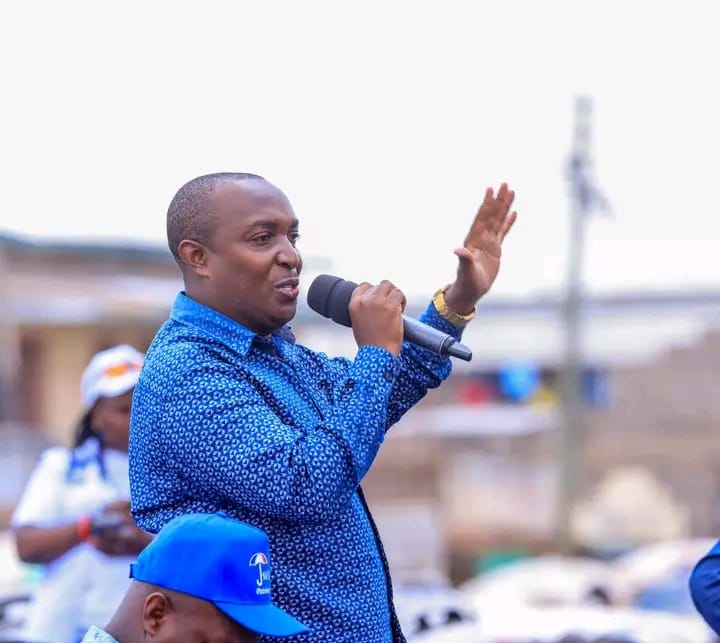
 Masii Ward aspirant Pascal Ndei Nzioki in a Past Political Rally. File Photo.


By Joseph Kaloki
Masii Ward aspirant Pascal Ndei Nzioki has faulted the current administration for what he termed as oppressive policies and misplaced priorities, arguing that they have significantly worsened the economic hardships facing Kenyans.
Speaking during a morning talk show on a leading television station in the Ukambani region, Nzioki claimed that the country has experienced a steady decline in critical sectors such as education, healthcare, and agriculture since the transition of power in 2022. He alleged that instead of addressing the economic challenges affecting ordinary citizens, the government is focusing on political survival and image management.
According to Nzioki, the administration has increasingly turned development projects into campaign tools, accusing President William Ruto of remaining in a perpetual campaign mode. He pointed to the President’s recent development narratives, including comparisons of Kenya’s development trajectory to Singapore, suggesting that such rhetoric is meant to deflect attention from unfulfilled promises.
Nzioki further claimed that many of the projects currently being highlighted by the government were conceptualised during the tenure of former President Mwai Kibaki and his then Vice President Stephen Kalonzo Musyoka. He argued that the current leadership has largely capitalised on past development blueprints while presenting them as new initiatives.
On the political front, the Masii Ward hopeful alleged that the President’s remarks regarding the viability of Azimio without the Orange Democratic Movement (ODM) were politically calculated. He claimed the administration is wary of the Opposition's development agenda, which he believes could challenge the government’s policy direction.
Nzioki maintained that opposition leaders are prioritising the establishment of free education and universal healthcare, accusing the government of failing to adequately fund public schools and hospitals. He argued that with proper leadership and prudent management of public resources, taxes collected from Kenyans would be sufficient to sustainably support free education and healthcare services.
He also raised concerns over what he described as “budgeted corruption,” alleging that some development projects are being financed for the personal benefit of political leaders. Nzioki specifically cited the Nyota Fund, which he claimed is a World Bank-supported programme that is allegedly being used for political mileage.
Additionally, he criticised the government’s handling of healthcare financing, claiming that consolidating health-related funds into a central account undermines the principles of devolution. He emphasised that devolved healthcare systems require financial autonomy to effectively serve county populations.
On the implementation of the Social Health Authority (SHA), Nzioki argued that the government failed to adequately sensitise the public, leaving many Kenyans confused about the new health financing model. He further noted that understaffing and poor infrastructure in education institutions continue to compromise the quality of learning across the country.
Nzioki concluded by asserting that Kenya’s most pressing challenge is leadership, expressing confidence that accountable and visionary governance would unlock the country’s potential and improve service delivery for citizens.
His remarks add to the growing political discourse around governance, service delivery, and economic management as the country continues to grapple with rising public concerns over the cost of living and access to essential services.