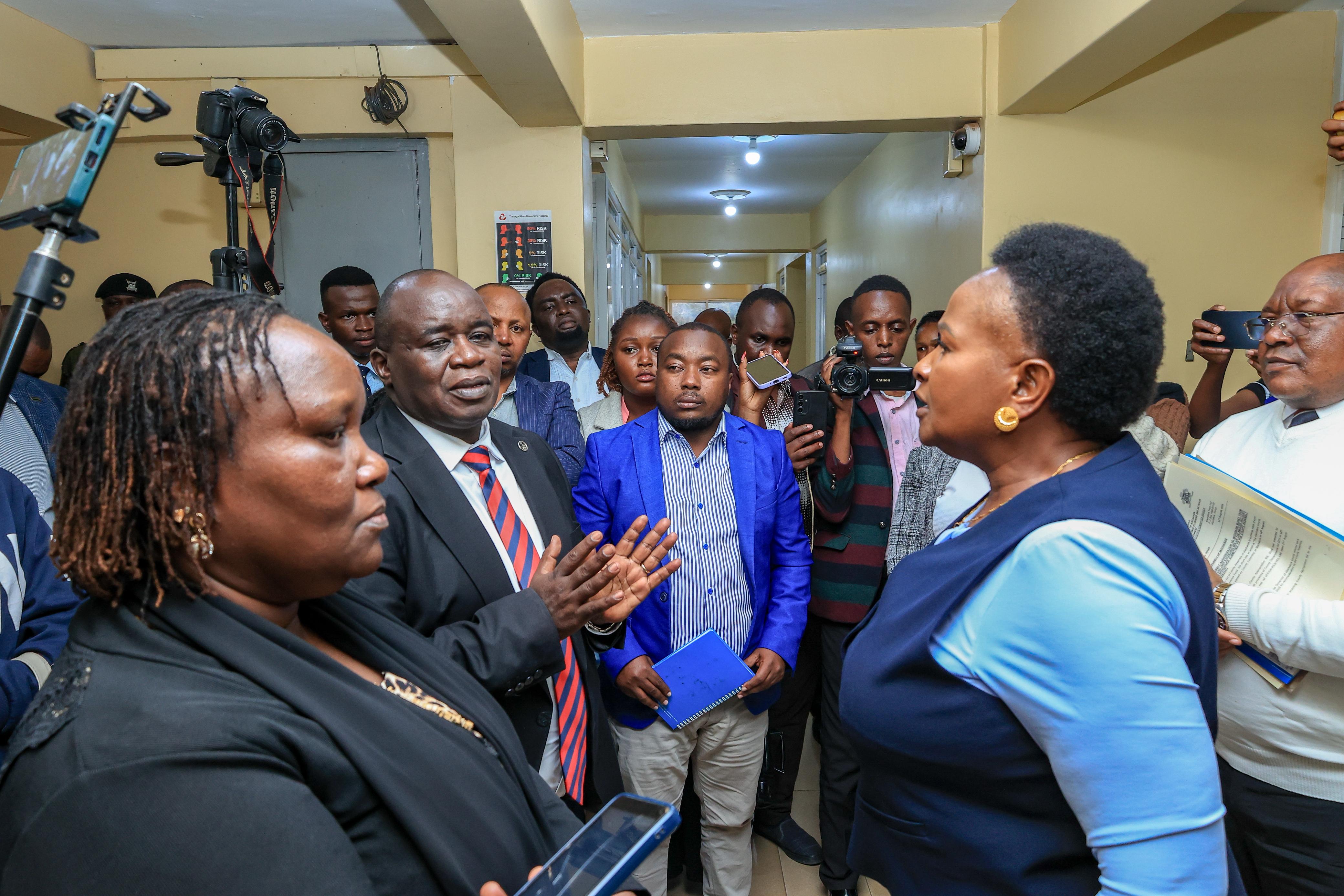
 Machakos Governor Wavinya Ndeti when she stormed the Machakos County Assembly. Photo Courtesy.


By Andrew Mbuva.
In a dramatic showdown that has sent shockwaves through Machakos County's political landscape, Governor Wavinya Ndeti has officially referred the Machakos County Appropriation Bill, 2026, back to the County Assembly, accusing legislators of unlawful budget interference that threatens public health, infrastructure, and the welfare of the county's most vulnerable residents.
The Governor, speaking during a press conference at the White House offices along People's Park, detailed how the Assembly slashed a staggering Kshs 853.96 million from executive budget proposals, stripping funds from essential services including road construction, garbage collection, revenue management systems, and youth empowerment programs.
She declared that the Assembly did not just amend a budget but systematically dismantled the very foundations of service delivery in the county, pointing out that they eliminated the entire Machakos Youth Services budget of Kshs 175.86 million, wiped out Kshs 78.32 million meant for garbage collection in the municipalities, and defunded the revenue collection system that brings in billions. She insisted that this was not oversight but sabotage.
Citing Section 24(2)(b) of the County Governments Act, 2012, the Governor invoked her constitutional powers to reject the Bill, warning that the Assembly's actions violate multiple legal provisions. She explained that Regulation 37(1) of the Public Finance Management Regulations clearly states that any increase or reduction to a budget vote ceiling must not exceed one percent of that vote's approved ceiling, and accused the Assembly of flagrantly violating this provision.
In some cases, they completely eliminated entire budgets, and notably increased their own development budget by Kshs 130 million above the agreed ceiling, extracting funds directly from public service delivery in direct violation of Section 129 of the Public Finance Management Act.
Perhaps the most alarming revelation was the complete elimination of the Kshs 78.32 million allocated for garbage collection in Machakos, Mavoko, and Kangundo-Tala municipalities.
The Governor stated that residents in Mlolongo, Athi River, Machakos Town, and Tala pay their refuse collection fees reliably, with collections reaching 135 percent of target just last year, and that to collect those fees while defunding the service is a betrayal of public trust.
She warned that uncollected garbage poses an immediate risk of cholera, typhoid, and water contamination, violating the county's constitutional duty under Articles 42 and 43 to maintain a clean and healthy environment.
The Governor reserved her harshest words for what she termed a direct assault on the youth of Machakos County. Under the Machakos Youth Empowerment Act, 2022, the Executive had allocated Kshs 175.86 million for the Machakos Youth Service, a program designed to deliver vocational skills, technical training, and youth employment opportunities.
She lamented that the Assembly wiped out every single shilling of that program, reducing it to zero, and when combined with the Kshs 100 million cut from youth empowerment transfers and the Kshs 30 million slashed from bursaries, the message was clear that the Assembly had turned its back on the youth of the county.
Additionally, the Wikwayto Fund for elderly care was reduced by Kshs 100 million from Kshs 137 million to Kshs 37 million, while the Empowerment of Women, Youth, and Special Groups suffered a similar Kshs 100 million cut. The County Bursary Fund was slashed by Kshs 30 million from Kshs 121.79 million to Kshs 91.79 million.
The Governor argued that stripping Kshs 30 million from school bursaries directly sends bright, needy children home for lack of fees, and that reducing funds for elderly citizens, persons with disabilities, and women in the informal economy violates Article 201(b)(i) of the Constitution, which demands equitable development and protection for marginalized groups.
The Governor also highlighted the devastating impact on grassroots administration, explaining that the Executive had allocated approximately Kshs 10.46 million to Machakos Sub-County and Kshs 10.23 million to each of the other eight sub-counties for grassroots administration, public participation, and service coordination.
However, the Assembly cut each sub-county's budget by Kshs 9.67 million, leaving eight sub-counties with barely Kshs 565,048 each for an entire financial year, roughly Kshs 47,000 per month to run an administrative unit serving hundreds of thousands of citizens.
She warned that disabling grassroots administration makes it impossible to supervise local health centers, inspect public works, or hold public participation forums, effectively neutralizing the primary objective of devolution.
Infrastructure projects were not spared either, with the Assembly slashing Kshs 65.38 million from the Kshs 396.64 million allocated to complete ongoing tarmacking of major arterial roads including the Katangi-Kithimani Road, the Mlolongo Phase 3-Gossip Road, and the Lita-Miti Muonza Road.
The Governor explained that these projects are actively under construction with awarded contracts, and under Kenyan law, a county government cannot appropriate less than what is required to satisfy existing contractual commitments. Gutting this allocation forces work to stall, exposes the county to heavy breach-of-contract lawsuits, interest charges, and idle-plant costs, and leaves partially completed roads to deteriorate in the rain, wasting millions in taxpayers' money already spent.
In a stern warning that could have far-reaching implications, the Governor cautioned that any Member of the County Assembly voting to maintain the unlawful variances would assume personal legal liability under public finance management laws for any loss, illegal expenditure, or contractual damages suffered by the County Government.
She also highlighted the short-sightedness of defunding the Integrated County Revenue Management System, pointing out that before its deployment, own-source revenue stood at Kshs 1.55 billion, but after implementation in August 2024, collections rose to Kshs 2.18 billion, a 39.7 percent increase, and reached Kshs 3.352 billion in 2025/2026, a 53.8 percent increase.
Wavinya noted that the 2026/2027 budget relies on a projected own-source revenue target of Kshs 4.93 billion, and defunding the very system that collects this revenue guarantees shortfalls that will bankrupt every other program in the county.
Section 24 of the County Governments Act provides a clear path forward, and should the Assembly choose to re-approve the Bill without incorporating the Governor's recommendations, the law requires a two-thirds majority of all members.
The Governor has called upon the Assembly Leadership to reconsider the Bill and pass a budget that serves all residents of Machakos, insisting that her decision was not made lightly and that she cannot in good conscience sign into law legislation that openly violates statutory limits, dismantles essential public services, undermines the county's financial foundation, and directly imperils the lives and livelihoods of the people.
Efforts to reach the Speaker of the Machakos County Assembly for comment were unsuccessful at the time of going to press, though sources indicate that the Assembly Leadership is expected to convene an emergency session to discuss the Governor's memorandum.
The standoff sets the stage for what could be a protracted political battle with significant implications for service delivery in Machakos County, as residents wait anxiously to see whether the Assembly will heed the Governor's call or escalate the confrontation.