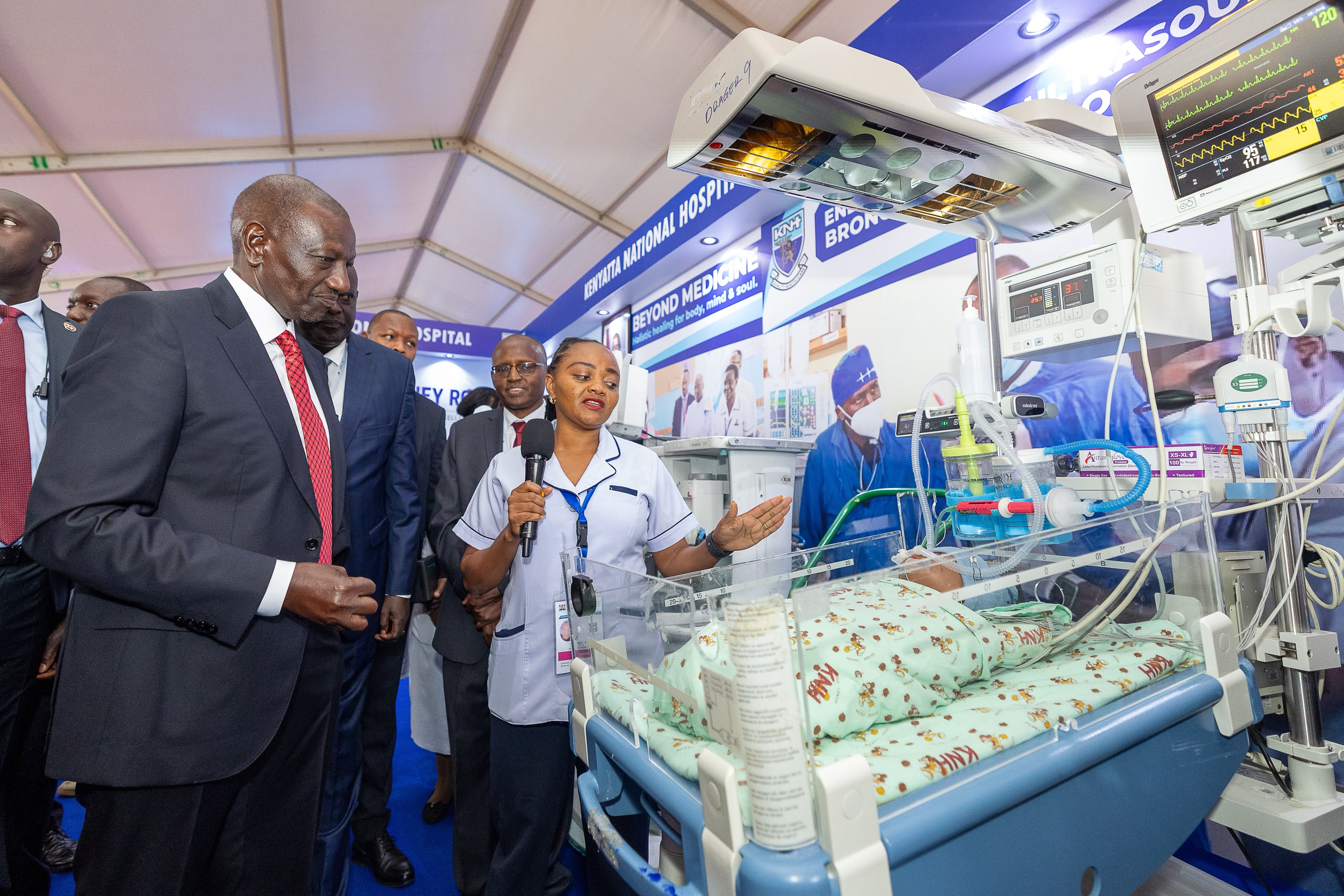
 President William Ruto during the official opening of the Kenya Health Summit, KICC, Nairobi on August 18, 2026. Photo by PPU.


By Fredrick Kioko.
President William Ruto has declared that Kenya has crossed an “historic threshold” in the implementation of Universal Health Coverage (UHC), saying the country now has a comprehensive legal, financial, institutional, community and digital framework for delivering healthcare to all citizens.
Speaking on Tuesday during the opening of the Kenya Health Summit 2026 at the Kenyatta International Convention Centre (KICC) in Nairobi, President Ruto said his administration had transformed the country's healthcare system to ensure that access to medical services is no longer determined by a person's ability to pay.
The President said universal healthcare was not merely a government promise but a constitutional obligation under Article 43, which guarantees every Kenyan the right to the highest attainable standard of health and provides that no person should be denied emergency medical treatment.
He noted that before the reforms, millions of Kenyans were forced to pay for healthcare from their own pockets, borrow money, sell property or organise harambees to meet medical bills.
According to Ruto, only about one in four Kenyans had health insurance by 2022, while fewer than one in 20 people in the poorest households were insured. He said Kenyans were spending an estimated Sh150 billion annually out of pocket on healthcare.
The President said the government responded by enacting four laws in October 2023 to establish the legal foundation for UHC. The laws created the framework for primary healthcare, replaced the National Hospital Insurance Fund (NHIF) with the Social Health Authority (SHA), established an integrated digital health system and allowed public health facilities to retain and reinvest their revenues.
Ruto said the reforms, which the government has branded Taifa Care, had already produced significant results, including the deployment of 107,800 Community Health Promoters across the country.
He said the promoters, equipped with smartphones and essential kits, have reached more than nine million households and referred over 750,000 people for further treatment.
The President said the government was also shifting healthcare from a system that waits for people to become seriously ill to one focused on prevention, early detection and timely treatment.
At the primary healthcare level, Ruto said the government had allocated Sh27.4 billion to the Primary Healthcare Fund and disbursed Sh23.3 billion. The funding, he said, had supported more than 20 million outpatient visits involving over 15 million Kenyans.
He further revealed that 32.3 million Kenyans are currently registered with SHA, with eight million having received treatment. More than 1.2 million mothers have also been supported to deliver safely, while over 500,000 surgical procedures have been covered through the system.
The government, he added, has sponsored nearly 560,000 vulnerable households, covering approximately 2.2 million Kenyans, while the Lipa SHA Pole Pole programme allows informal-sector families to make contributions progressively according to their financial circumstances.
Ruto cited cases of patients who have benefited from the new system, including an 18-year-old student whose specialised surgery at Kenyatta National Hospital cost Sh168,000 but was fully covered through SHA.
He also highlighted the case of a 42-year-old widow from Kisumu County who received specialised cancer treatment at Jaramogi Oginga Odinga Teaching and Referral Hospital. Her medical bill exceeded Sh250,000, while her annual SHA contribution stood at Sh7,000.
The President also announced progress in emergency medical care, pointing to the recently launched SHA 922 Lifeline and National Ambulance Dispatch Centre.
He said the free emergency service provides evacuation and the first 24 hours of stabilisation regardless of whether a patient is registered with SHA, eliminating the need for deposits or guarantees before emergency treatment.
On the supply of medicines, Ruto said the Kenya Medical Supplies Authority (KEMSA) order-fill rate had improved from about 40 per cent to 91 per cent.
He said the government had recapitalised KEMSA with Sh1.5 billion and extended a Sh10 billion credit line to strengthen the country's medical supply chain, with the ultimate target being a 100 per cent order-fill rate.
The President also defended the government's digitisation of the health sector, saying the reforms were designed to eliminate fraud and improve accountability in the management of medical claims.
He cited cases of fictitious patients, inflated bills and claims for procedures that had never been performed, saying digitisation would make every patient visible, every treatment traceable and every shilling accountable.
However, Ruto acknowledged that significant work remained, saying the government needed to make SHA registration easier, clarify benefits, speed up claims processing, improve digital systems and ensure more consistent quality of care across the country.
He said the success of the reforms should ultimately be measured not by the number of laws enacted or people registered, but by whether patients receive dependable, affordable and dignified care.
The President called on the national and county governments, Parliament, development partners, private-sector players, civil society, healthcare professionals and communities to use the two-day summit to evaluate the progress made and identify areas requiring improvement.
He said universal healthcare should transcend individual governments and political parties, becoming a permanent national commitment.
“Universal healthcare must become part of our national covenant; not an achievement of a government, a party, or a President, but of the people and of the Republic,” Ruto said.
He declared the Kenya Health Summit 2026 officially open, urging stakeholders to strengthen the reforms already in place and safeguard them for future generations.