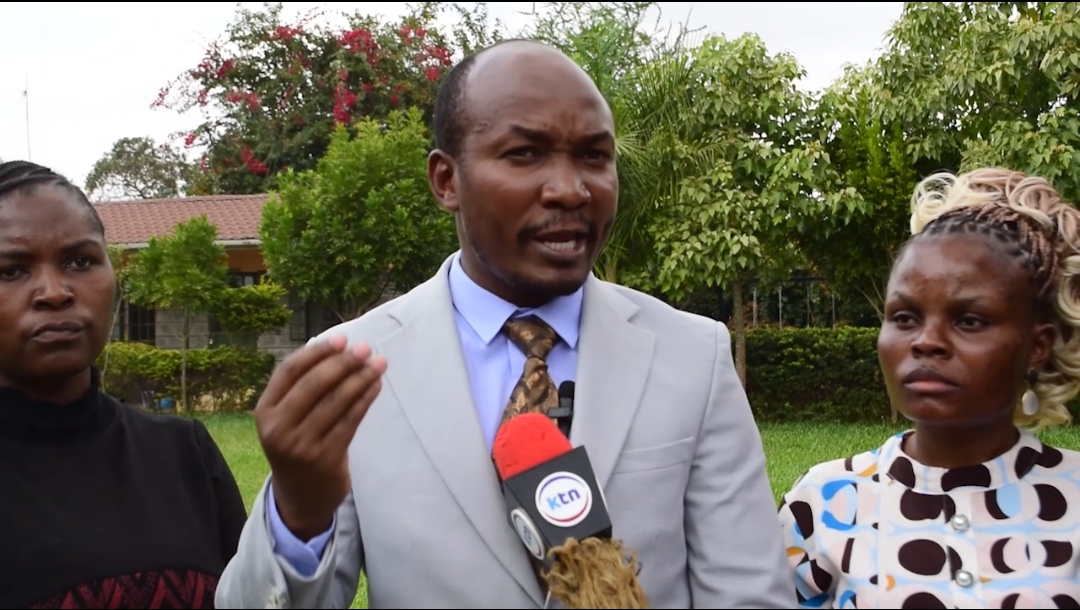
 Kenya Union of Clinical Officers (KUCO) Makueni County Chairperson Mathew Sila. Photo by Fredrick Kioko.


By Fredrick Kioko
Striking clinical officers in Makueni County have vowed to continue with the ongoing nationwide industrial action, accusing the county government of failing to address their grievances and instead engaging in politics at the expense of healthcare delivery.
Led by Kenya Union of Clinical Officers (KUCO) Makueni County Chairperson Mathew Sila, the officers said the strike had entered its 27th day, disrupting services across more than 200 health facilities in the county and leaving patients struggling to access medical care.
Speaking in Kathonzweni, Sila said the prolonged dispute was affecting not only healthcare workers but also residents who depend on public health facilities.
“It has taken us 27 days out. We are affecting service delivery, and health is critical,” Sila said.
He accused the county administration of failing to take responsibility for the crisis, arguing that a motivated and functional workforce was essential if the county government was to deliver on its development promises.
“For the government of Makueni to achieve and realise the results that it has promised people in its manifesto, they must have a functional, healthy human resource,” he said.
Sila said the situation had become particularly difficult for patients seeking outpatient services, with some being forced to seek care elsewhere.
“The public is struggling. They have to come to Makueni County Referral, which is not accepting SHA in terms of outpatient. It becomes extremely chaotic,” he said.
He further described the crisis as “man-made” and called for county officials responsible for the health docket to be held accountable.
“Somebody should not roam around saying that everything is well. It is true that there is a serious crisis, and the crisis is man-made,” Sila said.
The union chairperson said the grievances were not new, noting that the national and county governments had held a meeting with health officials on April 20, where a task force was established to address the outstanding issues.
Among the key issues agreed upon were the full implementation of the clinical officers’ career guidelines, signing of a Collective Bargaining Agreement (CBA), establishment of the Directorate of Clinical Services, payment of outstanding gratuity, review of hospital contracts and the welfare of programme officers.
According to Sila, the task force completed its work and set clear timelines, including signing the CBA by April 30.
“To date, the CBA has not been signed. What is the cost of signing the CBA? It is zero. It only requires you to append a signature,” he said.
He urged the county leadership to sign the agreement and deposit it with the Salaries and Remuneration Commission (SRC), saying the process only required the relevant officials to append their signatures.
The striking clinical officers are also demanding implementation of an enhanced risk allowance contained in a return-to-work formula signed on January 28, 2026.
They want the allowance increased from the current KSh3,000 to KSh7,000, together with payment of accrued arrears.
Other demands include the establishment and operationalisation of the Office of the Director of Clinical Services at Job Group R, full alignment of serving clinical officers in accordance with their career guidelines and absorption of 110 clinical officers currently working under hospital contracts.
Sila also challenged the county government to engage the union directly instead of waiting for industrial disputes to escalate.
“We are not desperate. We are only trying to beg you to do the right thing,” he said.
He called on Makueni Governor Mutula Kilonzo Jr. to intervene and provide direction towards resolving the dispute, warning that continued industrial action was undermining the county’s health system.
Sila further criticised what he termed divisive politics in the management of human resources, saying Makueni, which had previously been regarded as a leader in human resource management among counties in the eastern region, was now “beginning to go backwards.”
“There must be an effective, robust workforce that is motivated. And they can never be there when you are using divisive politics, lying to the public and moving around instead of sitting down and performing your noble duty,” he said.
He also appealed to governors in other counties facing similar disputes, particularly Isiolo and Embu, to sign the CBAs and address the grievances of clinical officers.
The union official dismissed claims that clinical officers were solely responsible for the disruption of services, arguing that the government had failed to honour commitments contained in return-to-work agreements.
“Clinical officers are not on strike. The government is the one that moved away and abdicated responsibility by not honouring what we agreed when we were signing the return-to-work agreement,” Sila said.
He maintained that the return-to-work agreements had been deposited in court and therefore should be honoured.
“When you are not able to implement, you are the one on strike,” he said.
Sila urged the county government to engage the union on what it could afford to implement immediately rather than allowing the standoff to persist.
“Call us and tell us, this is what we are able to pay in this supplementary budget, this is what we will do,” he said.
He further called for meaningful engagement between the county government and health workers, invoking the human resource management framework that recognises unions as key stakeholders.
“It is not just about politics every day. It is about ensuring that there is functional, emotional engagement, not calling us when there is a crisis and then from there you start moving around,” he said.
The union has maintained that the strike will continue until the outstanding issues—including the CBA, risk allowance, career progression, establishment of the Directorate of Clinical Services and absorption of contracted clinical officers—are addressed.