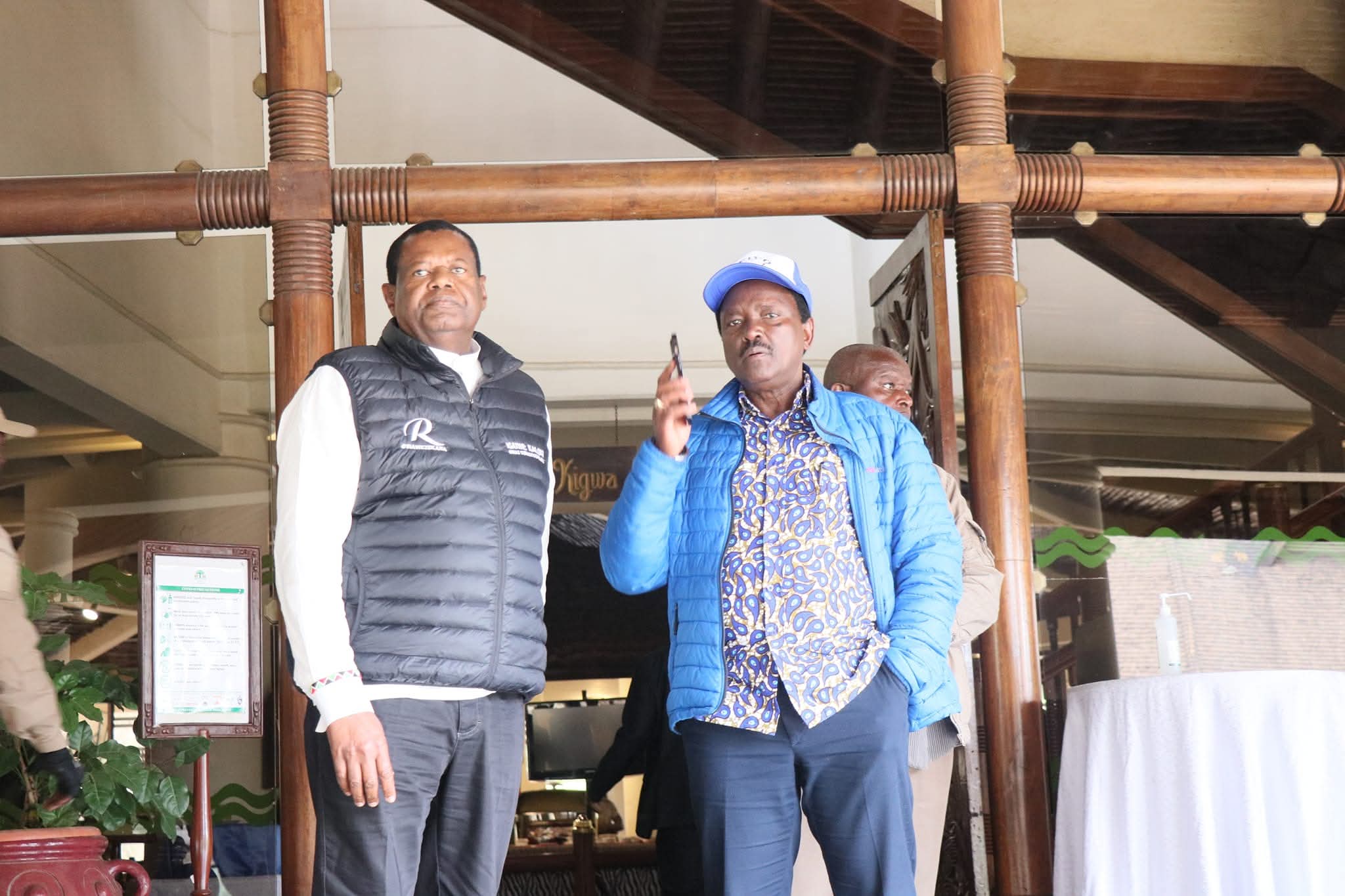
 Wiper leader Kalonzo Musyoka with Prof. Philip Kaloki at an undisclosed place. File Photo.


By Andrew Mbuva.
Prof. Philip Kaloki's decision to leave the Wiper Democratic Movement and join the United Democratic Alliance (UDA) has sparked intense political debate across Makueni County. While critics have dismissed the move as ordinary party hopping, many of his supporters see it differently. To them, Kaloki's exit marks the culmination of years of political frustration, repeated disappointments, and what they describe as a pattern of being denied opportunities within the party he remained loyal to for years.
Whether one agrees with that assessment or not, Kaloki's political journey reveals a recurring narrative of unfulfilled expectations that has shaped his relationship with Wiper leader Kalonzo Musyoka.
The 2013 Governorship: A Promising Start That Ended in Disappointment
The first major turning point came ahead of the 2013 General Election.
Kaloki emerged as Wiper's preferred gubernatorial candidate in Makueni without facing any significant internal challenge. On paper, he was the party's official flag bearer.
However, according to his supporters, events on the campaign trail painted a different picture.
One of the earliest signs came during a meeting convened by then Vice President Kalonzo Musyoka at his official Karen residence. The meeting brought together Makueni professionals and included Prof. Kivutha Kibwana, who at the time served as a presidential advisor on constitutional affairs.
During the meeting, Kalonzo reportedly expressed his desire to work with Kibwana in Makueni. Although the remarks appeared harmless to some, Kaloki's supporters interpreted them as an indirect endorsement of a rival candidate who was contesting under the Muungano Party.
The question many asked was straightforward: why would the leader of Wiper publicly praise a candidate from another party while his own party had already settled on Kaloki?
That perception only deepened during the presidential campaign tour across Makueni.
In Kibwezi, where Kaloki enjoyed considerable support, enthusiastic supporters repeatedly chanted his name. Yet when Kalonzo addressed the crowd, he reportedly stopped the chants and declined to invite Kaloki to speak, insisting that the event was strictly a presidential campaign rather than a forum for local politics.
Ironically, when the campaign reached Nunguni—an area where Kibwana commanded significant support—Kalonzo reportedly invited Kibwana to address the gathering.
To Kaloki's supporters, the contrast was impossible to ignore.
The election results appeared to validate their fears. Kibwana won the governorship under the Muungano Party ticket, defeating Kaloki despite Wiper's numerical strength in the county.
A Political Setback Turned into a Development Legacy
Following the defeat, Kaloki joined the Jubilee Party and unsuccessfully contested the Makueni Senate by-election following the death of Senator Mutula Kilonzo Snr.
Although he lost to Mutula Kilonzo Jnr, the Jubilee administration appointed him Chairman of the Kenya Medical Training College (KMTC).
It is during this period that Kaloki rebuilt his political image.
Under his leadership, KMTC expanded significantly, with several campuses established across the country, including multiple branches in Makueni County.
These projects earned him the nickname "Kaloki wa Maendeleo," branding him as a leader associated with tangible development rather than political rhetoric.
The Kambu Declaration: Another Closed Door
As the 2017 elections approached, many expected Kaloki to return and challenge for the Makueni governorship.
Instead, another political development altered the equation.
Through what became known as the Kambu Declaration, Wiper entered into a cooperation agreement with the Muungano Party, allowing Governor Kivutha Kibwana to defend his seat on a Wiper ticket.
For Kaloki's supporters, history appeared to be repeating itself.
The agreement effectively closed the door for anyone else hoping to seek the party's gubernatorial nomination, including Kaloki.
Unable to compete for governor under Wiper, Kaloki contested the Kibwezi East parliamentary seat on a Jubilee ticket but lost to Jessica Mbalu of Wiper.
Nevertheless, President Uhuru Kenyatta's administration retained him as KMTC Board Chairman, enabling him to continue championing development initiatives that strengthened his grassroots appeal.
The 2022 Promise That Never Materialized
Ahead of the 2022 elections, Kaloki returned to Wiper after reportedly receiving assurances that, with Kibwana retiring, the party would conduct free and fair nominations for the Makueni governorship.
Many believed this would finally provide him with the opportunity he had waited for over a decade.
Instead, events took another unexpected turn.
Rather than contesting in Makueni, Kaloki was persuaded to relocate to Nairobi and become the running mate of ODM gubernatorial candidate Polycarp Igathe.
According to sources familiar with the campaign, Kaloki struggled to mount an effective campaign because he allegedly lacked sufficient logistical and financial support from the party.
The Igathe-Kaloki ticket eventually lost to UDA's Johnson Sakaja.
For many of Kaloki's supporters, the Nairobi assignment represented yet another diversion from his long-standing gubernatorial ambitions in Makueni.
The Mombasa Proposal: The Final Straw?
Despite the Nairobi defeat, Kaloki remained in Wiper and continued mobilizing his Makueni supporters in preparation for the 2027 elections.
His expectation, according to allies, was that he would finally compete fairly for the Makueni governorship.
However, political insiders claim that Kalonzo recently floated another proposal—this time suggesting Kaloki could become the running mate of the Mombasa Opposition Governor Candidate Mohammed Ali.
To Kaloki's supporters, the suggestion revived memories of previous episodes where they believed his ambitions in Makueni had been redirected elsewhere.
One source close to Kaloki's political circle told Soo TV that the proposal convinced him that his gubernatorial ambitions would once again be postponed indefinitely.
According to the source, joining UDA became the only viable path toward pursuing his political future in Makueni.
Why Many Makueni Voters Welcomed the Move
Kaloki's switch to UDA has received a warm reception among many of his supporters, who argue that he has endured years of political sacrifices without receiving a genuine opportunity within Wiper.
They believe his move represents more than a change of party; it is an attempt to take control of his own political destiny.
His supporters also argue that his development record through KMTC demonstrates administrative capability and gives him credibility beyond partisan politics.
Additionally, Kaloki appears to be attracting support from sections of former Wiper members who feel sidelined by the party's internal nomination processes over the years.
A New Political Equation for Makueni
For decades, Wiper has maintained an almost unchallenged grip on Makueni politics.
Kaloki's entry into UDA introduces a new dynamic that could significantly reshape the county's political landscape ahead of the 2027 elections.
Whether his gamble succeeds remains to be seen. However, one thing is increasingly evident: Prof. Philip Kaloki enters the race carrying a compelling political narrative—one built around perseverance, perceived betrayal, and the promise of a fresh beginning.
If he succeeds in converting that narrative into votes while capitalizing on his development credentials and growing support base, Makueni could witness its most competitive gubernatorial contest in years.