
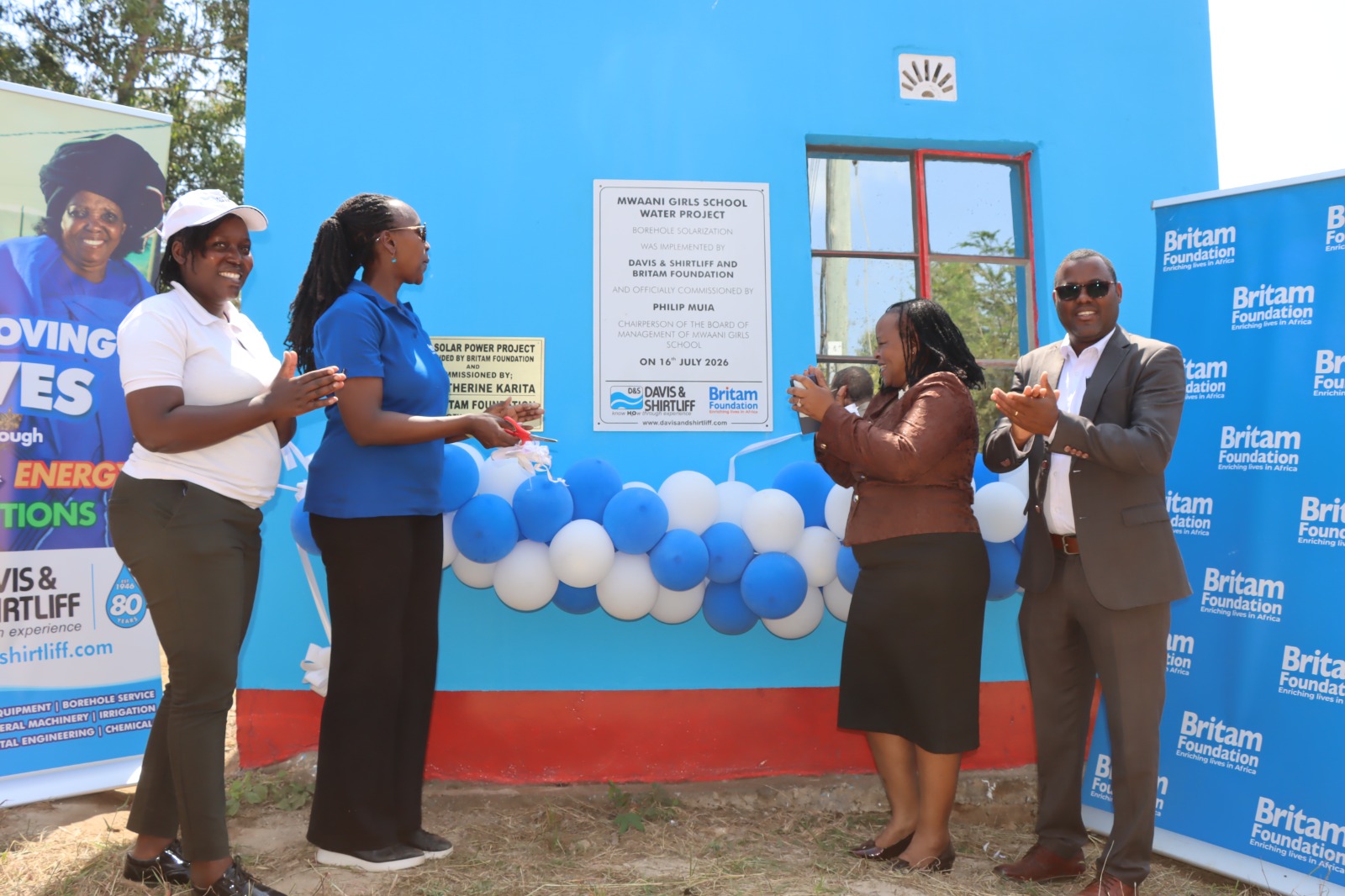
 From Left: Engineer Lydia Onditi of Davis and Shirtliff, Catherine Karita CEO Britam Foundation, Dr. Elizabeth Mutinda Principal Mwaani Girls' and Dr. Philip Muia the School BOM Chair during the Commissioning of a Solar powered system at the School's Borehole. Photo by Presley Kyalo.


By Andrew Mbuva.
For years, water scarcity has posed a major challenge at Mwaani Girls' High School in Makueni County, straining the institution's resources and affecting the daily lives of more than 1,800 students. That challenge is now set to become history following the commissioning of a solar-powered borehole pumping system by the Britam Foundation in partnership with Davis & Shirtliff.
The project, officially unveiled on Thursday, is expected to provide the school with a reliable, sustainable and cost-effective water supply while significantly reducing electricity costs associated with pumping water.
Speaking during the commissioning ceremony, Britam Foundation Chief Executive Officer Catherine Karita described the project as part of the foundation's commitment to enriching lives through investments in education, health, environmental conservation and community development.
Karita said she was deeply impressed by the school's cleanliness, organization and the confidence displayed by the students.
"I visit many schools, but the moment I walked through the gates of Mwaani Girls, I was mesmerized. It is a very clean and organized school, and the entertainment by the students was world-class. It reflects great creativity and confidence among these young women," she said.
She explained that the Britam Foundation is the corporate social investment arm of Britam Holdings, a company that has operated for six decades with a mission of safeguarding dreams and aspirations.
"Our purpose is to enrich lives across Africa, beginning here at home in Kenya. One of the ways we do this is by providing clean water to schools because water is life. When schools have access to clean water, health improves, happiness increases and learners are able to concentrate fully on their education," she said.
Karita noted that the foundation operates under four key pillars—health and wellness, education, environmental conservation and financial empowerment—with access to clean water playing a critical role in improving learning environments.
She added that the use of solar energy in the project demonstrates the foundation's commitment to environmental sustainability by harnessing renewable energy while reducing operational costs.
"We believe in protecting our environment through renewable energy and tree planting. The sun is available every day, and we should harness it to improve lives while conserving our planet," she said.
Engineer Lydia Onditi of Davis & Shirtliff said the company, which is celebrating 80 years of operations, was proud to partner with the Britam Foundation in delivering sustainable water and energy solutions to schools and communities.
She said Davis & Shirtliff operates in nine African countries and employs more than 1,000 engineers, making it one of Kenya's largest engineering employers.
Onditi encouraged the students to embrace Science, Technology, Engineering and Mathematics (STEM), noting that engineering presents vast career opportunities.
"When I entered the school, I noticed the emphasis on STEM. I want to encourage you to pursue those subjects because companies like Davis & Shirtliff require engineers and innovators. Take good care of the equipment we have installed and use it as a learning resource," she said.
Mwaani Girls' Principal Dr. Elizabeth Mutinda described the commissioning as a dream come true, saying the project would have a lasting impact on the institution.
She thanked the Britam Foundation and Davis & Shirtliff for responding to the school's long-standing water challenges and acknowledged the leadership of the Board of Management for pursuing a lasting solution.
"Our school is home to more than 1,800 students. Water is the lifeblood of this institution. It supports learning, sanitation, cooking, cleaning and the overall well-being of our learners and staff," she said.
Dr. Mutinda revealed that the school consumes enormous quantities of water daily and that the solar-powered system will substantially lower electricity expenses.
"The savings from reduced electricity bills will now be redirected towards improving learning resources, supporting student programmes and enhancing our facilities. This is not just a water project; it is a long-term investment in quality education," she said.
She also challenged the students to safeguard the new facility and draw inspiration from the women leaders who attended the event.
"The presence of these successful women sends a powerful message that education can take you anywhere. Let this project inspire you to work hard and one day transform other people's lives just as yours have been transformed today," she added.
Board of Management Chairperson Dr. Philip Muia recalled how the project started with a simple request for assistance to the Britam Foundation despite Makueni not being among the foundation's priority regions at the time.
"When I approached Catherine, she told me Makueni was not their focus then, but she promised to see what she could do. Soon after, an assessment team visited the school, a report was prepared, installation began and today we are commissioning the completed project," he said.
Dr. Muia said the impact of the investment extends far beyond the school's infrastructure.
"People may say you have only solarized a borehole, but what you have truly done is touch the lives of over 1,800 students, teachers, parents and the wider community. The impact is enormous, and I encourage the Britam Foundation to continue transforming communities wherever it goes," he said.
He also challenged both teachers and students to believe in their potential, saying success begins with a determined mindset.
The solar-powered water project is expected to guarantee a steady supply of clean water throughout the year while promoting environmental sustainability through renewable energy. School leaders say the initiative will improve hygiene, sanitation and the overall learning environment, allowing the institution to redirect financial savings towards enhancing academic programmes and student welfare