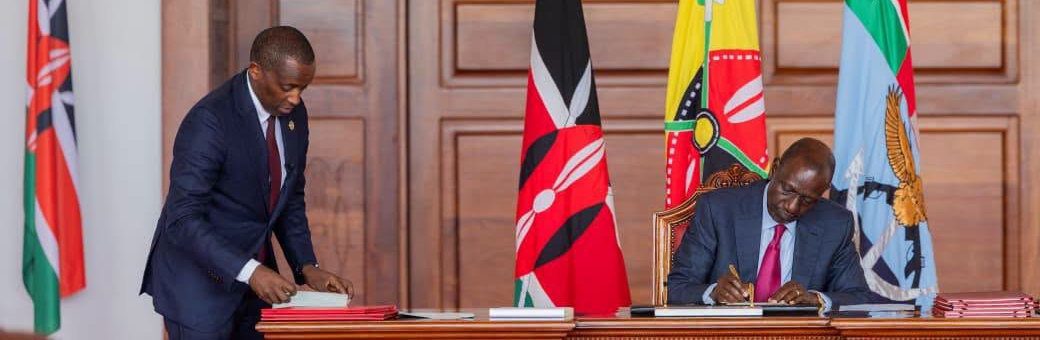
 President William Ruto has assented to the Finance Bill, 2026, the Appropriation Bill, 2026, and the Supplementary Appropriation Act, 2026, paving the way for the implementation of the government's 2026/27 Budget and development agenda.


By Fredrick Kioko,
President William Ruto has assented to the Finance Bill, 2026, the Appropriation Bill, 2026, and the Supplementary Appropriation Act, 2026, paving the way for the implementation of the government's 2026/27 Budget and development agenda.
Speaking during the signing ceremony at State House, Nairobi, the President said the new laws provide the legal framework and financial resources needed to fund key national priorities, create jobs, improve livelihoods, and drive economic transformation.
Ruto dismissed claims that the Finance Act, 2026, introduces new taxes, insisting that the legislation focuses on improving fairness in the tax system by strengthening compliance, sealing loopholes, and ensuring individuals and businesses pay taxes that are legally due.
"We are pursuing tax avoidance, not taxpayers; offshore schemes, not ordinary wages; and leakages, not livelihoods," the President said.
He further sought to reassure Kenyans, stating that the law does not impose taxes on freehold land, second-hand clothing (mitumba), rental income, bottled water, M-PESA and other mobile money transactions, mobile airtime and data, or locally manufactured packaging used for essential products.
The President highlighted increased allocations to key sectors in the 2026/27 Budget. Education received the largest share at KSh784 billion, up from KSh526 billion in 2022, while health funding rose from KSh132 billion to KSh175 billion. Agriculture was allocated KSh63 billion, an increase from KSh44 billion four years ago.
To cushion consumers against fluctuations in fuel prices, the government has also set aside KSh21.5 billion for fuel stabilisation measures.
Ruto said the budget reflects the government's commitment to investing in people, boosting productivity, and promoting shared prosperity across the country.