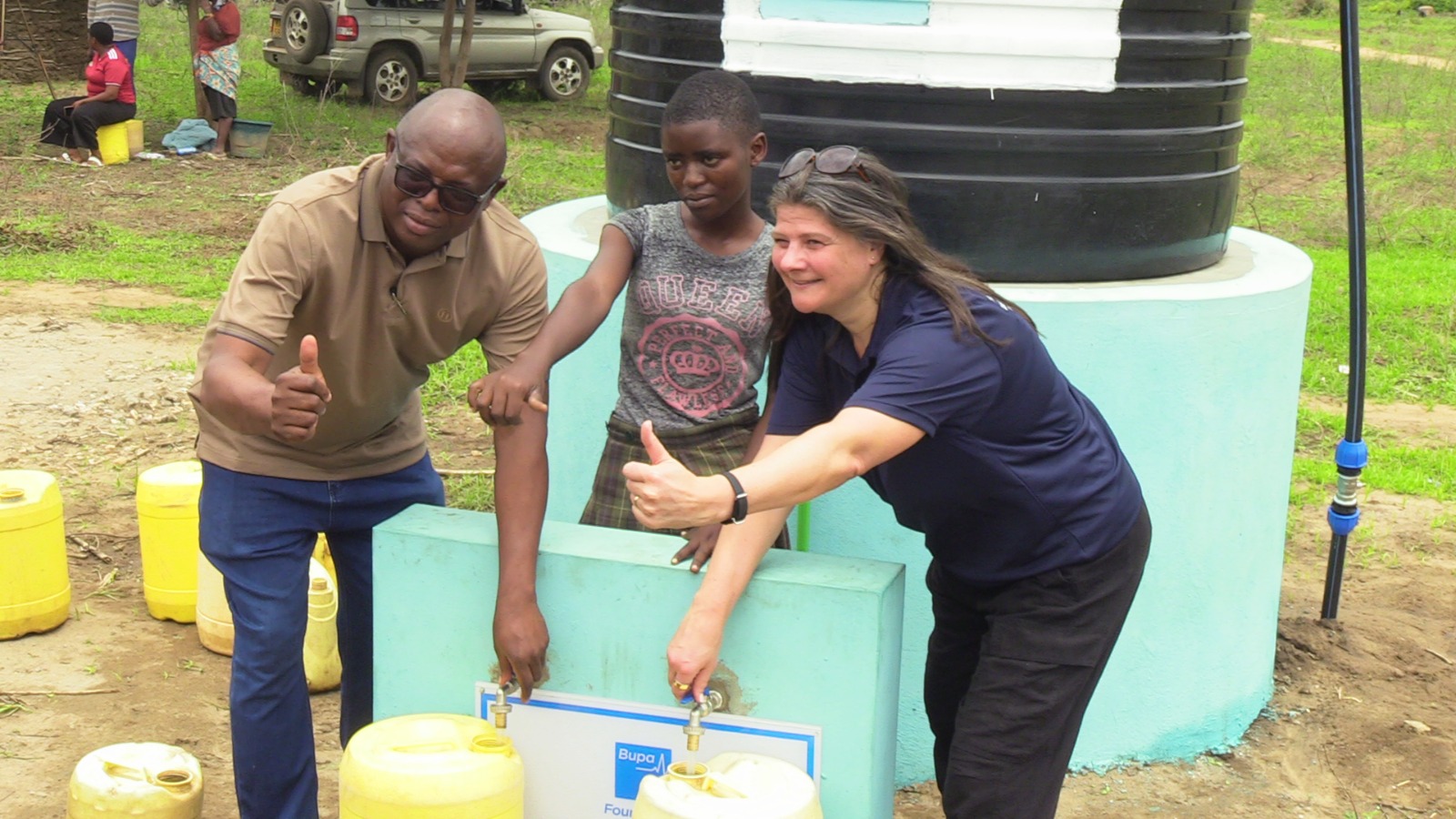
 Residents of Mwangaza village in Garashi ward, Magarini Sub County led by Mrs Janet Chanzera and Garashi ward Member of County Assembly (MCA) Theophilus Fondo join officials from the British United Provident Association (BUPA) Global Kenya and Bupa Foundation during the official opening of a solar power clean water borehole at Mwangaza village. Photo by Ben Okweingoti


By Ben Okweingoti.
More than 11,000 residents from three villages in Garashi Ward, Magarini Sub-County in Kilifi County are set to benefit from a new solar-powered borehole project aimed at improving access to clean and safe water.
The initiative, funded by the British United Provident Association (BUPA) Global Kenya through its Bupa Foundation, is expected to transform the lives of communities that have for decades relied on unsafe water sources along the Sabaki River.
For years, residents living along the river have struggled to access clean water due to the presence of crocodiles and hippos, as well as contamination from debris and other pollutants carried by the river.
The newly commissioned project comprises a borehole, a four-kilometre water pipeline, and elevated high-capacity water tanks installed across three villages. The infrastructure is designed to supply clean water to households, two health facilities, and a school, significantly improving hygiene and sanitation in the area.
Areas expected to benefit from the project include Garashi Centre, Kadongoleni Village, Mwangaza Village, Kalongoni Village, Garashi Health Centre, and Garashi Primary School, which has an enrolment of 710 pupils.
Residents say the project has brought much-needed relief to a community that has long endured water scarcity and safety risks while collecting water.
Janet Chanzera, a resident of Garashi, said families previously relied on the Sabaki River, shallow wells, and hand-dug water pans, sources that were often unsafe for consumption.
“We have had people attacked by crocodiles and hippos while fetching water from the river, and this is after walking more than six kilometres from their homes,” she said. “Our area has also experienced frequent outbreaks of waterborne diseases such as cholera, bilharzia, and typhoid, forcing families to spend heavily on treatment.”
Chanzera added that the new installation offers a sustainable solution that will reduce the burden of water collection while improving sanitation, health outcomes, and community resilience.
“Women struggled a lot while fetching water with their children, and sometimes girls missed school because they had to help their mothers. Now water has reached our villages, our school, and even our dispensary, and it has been piped closer to our homes,” she said.
She also noted that the situation was previously worsened during flooding seasons when access to the river became even more dangerous.
“During the severe floods in 2018, many villages were cut off, and wild animals sought refuge in areas where people lived. Access to clean water became a major challenge. With this borehole now fortified and powered by solar energy, we believe water will remain available even during floods,” she said.
Another resident, Riziki Kaingu Karisa, said the project will significantly ease household chores and eliminate the hardships residents faced in the past.
“We are very grateful because this water will help us with washing, bathing, drinking, and cooking. Before, we had to fetch water from faraway places. If you had money you could send a motorcycle to bring water, but if you didn’t, you had to carry it on your head,” she said.
Garashi Ward Member of County Assembly Theophilus Fondo said the area has historically experienced severe water shortages, particularly during dry seasons, but expressed optimism that the project will resolve most of the challenges.
“Bupa Foundation has supported many people in this area through this water project. Water has been a major challenge here. Most of the Coast region depends on water from Baricho where Coast Water has its wells, but in the past six months drought caused serious shortages,” he said.
Fondo added that residents had been subjected to frequent water rationing, but the new project is expected to significantly reduce the problem.
“With this project in place, our people will no longer suffer from severe water shortages as they did before,” he said.
Bupa Global Kenya Chief Executive Officer and Principal Officer Uditha Jayaratne said the project demonstrates the organization’s commitment to strengthening community partnerships and improving livelihoods through sustainable water solutions.
“The Garashi borehole builds on three previous installations across Kilifi County, which so far allow over 33,000 residents to access clean and safe water. With this fourth project, we are moving closer to our ambition of expanding clean water access to 100,000 people by 2028,” she said.
Kilifi County Chief Officer for Water and Natural Resources Lawrence Mwazogha welcomed the project, describing it as an important step towards achieving universal access to clean water in the county.
“Since 2022, the County Government of Kilifi has invested significantly in expanding water access by laying more than 478 kilometres of pipeline across the county. However, despite this progress, many communities still experience water rationing due to supply challenges,” he said.
Mwazogha added that partnerships with stakeholders such as Bupa Global Kenya will play a crucial role in ensuring more households, schools, and health facilities gain reliable access to safe water.
“We are grateful for this borehole project, which not only provides clean water to key institutions but also empowers the local community to manage the system sustainably for the long term,” he said.