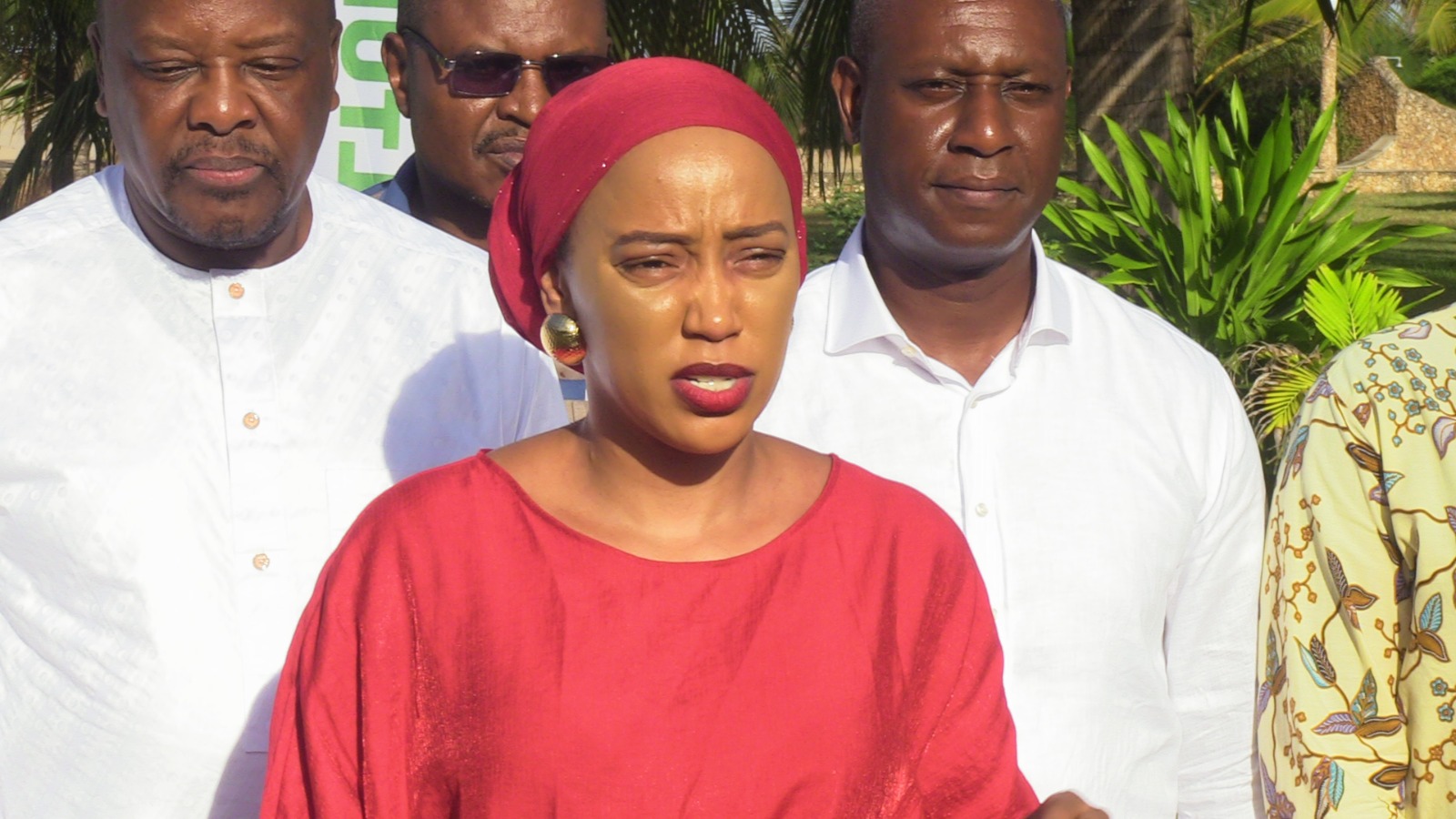
 Livestock and Fisheries committee member, nominated Senator Hezena Lemaletian, Cabinet Secretary for agriculture and livestock Mutahi Kagwe, the Senate Agriculture and the chairperson of the Agriculture and Livestock committee in the National Assembly and Tigania West MP John Mutunga brief journalists after attending a four day agriculture sector retreat at Ocean Beach Resort in Malindi town, Kilifi County on Friday, April, 10, 2026. Photo by Ben Okweingoti.


By Ben Okweingoti.
Legislators from National Assembly of Kenya and Senate of Kenya have called for a significant increase in budgetary allocation to the agriculture and livestock sector, warning that underfunding continues to undermine the country’s food security and economic growth.
Speaking after a consultative meeting with state corporation heads and ministry officials at a hotel in Malindi, the Chairperson of the National Assembly’s Agriculture and Livestock Committee, John Mutunga, alongside Senator Hezena Lemaletian, emphasized the urgent need for increased funding to support research, training, and productivity in the sector.
The lawmakers noted that agriculture contributes approximately 25 percent to Kenya’s Gross Domestic Product (GDP) and employs over 40 percent of the country’s labour force. Despite this, the sector receives only about 3 percent of the national budget.
In the 2026/2027 financial year, the agriculture docket is facing a funding shortfall of Sh59 billion, having been allocated Sh75.49 billion against a requirement of Sh135.36 billion. This gap, legislators warned, threatens the successful implementation of the Bottom-Up Economic Transformation Agenda (BETA), particularly in critical areas such as crop and livestock value chains.
Budget estimates further show that the State Department for Agriculture has been given a ceiling of Sh59.99 billion against a demand of Sh107.36 billion. Under the Budget Policy Statement, the ministry’s allocation comprises Sh29.74 billion for recurrent expenditure and Sh45.74 billion for development, representing just 2.7 percent of the Sh2.8 trillion national budget.
Dr Mutunga lamented that Kenya spends more than Sh500 billion annually on food imports—funds he said could instead be directed toward boosting local production and advancing agricultural technology.
“We must negotiate with the National Treasury to ensure agriculture receives funding commensurate with its importance. If we are serious about import substitution, then investing in local production is the way to go,” he said.
He revealed that over 15 bills related to agriculture are currently before the National Assembly, including executive and private members’ bills. Among the key legislations already processed is the Food and Feed Safety Regulatory Bill, which he described as critical to strengthening the sector.
Senator Lemaletian noted that the Senate is also handling several agricultural bills, some of which are at mediation stages to avoid duplication between the two Houses.
She highlighted persistent challenges, including staffing shortages in agricultural parastatals and inadequate funding for agricultural education institutions.
“There is a clear gap in funding for students pursuing agriculture-related courses. As legislators, we are committed to lobbying for increased support to ensure these students receive adequate funding, just like those in other sectors,” she said.
The Senator further stressed the need for Kenya to transition from a consumption-driven economy to a production-oriented one, anchored on a robust agricultural sector.
Both lawmakers agreed that aligning budgetary allocations with the sector’s contribution to the economy is essential for driving growth and industrialization.
“If agriculture is the pillar of our economy, then its funding must reflect that reality. We are not asking for more resources to consume, but to increase production and grow the country,” Dr Mutunga added.