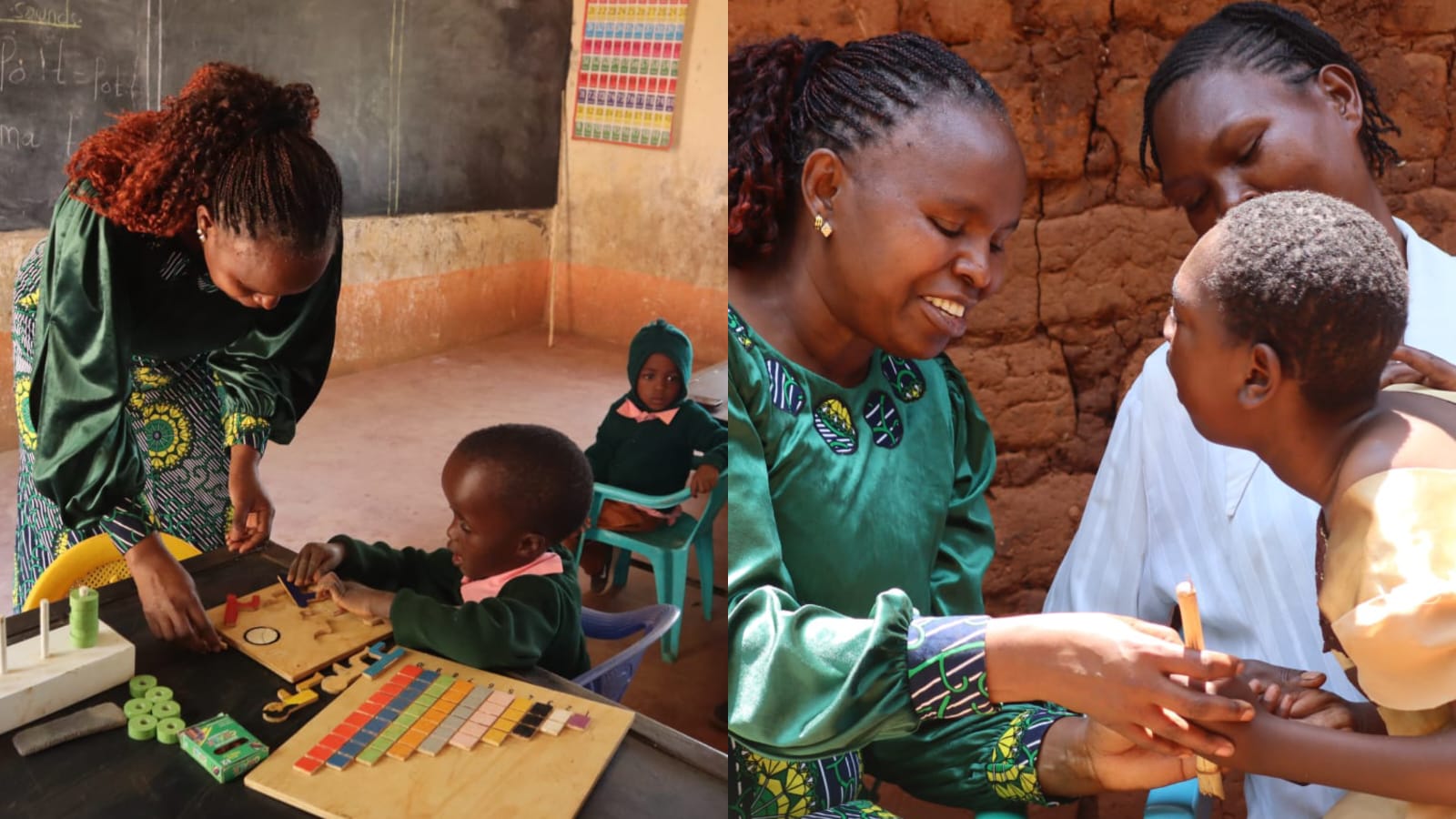
 First Photo: Teacher damaris teaching Mumo who's in an integrated PP2 class at Kombuni Junior Primary School in Kalama Subcounty, Machakos. Second Photo: Teacher Damaris taking home based education to Eunice Mwende's home to do education therapy. Eunice is CP born and is 14yrs. Photos by Virginia Siebella.


By Electine Otieno
Every morning, Damaris Mbithe sets out on a journey that few teachers would undertake. With a bag of books slung over her shoulder, she moves from one homestead to another across the scattered villages of Kalama Subcounty, sometimes traveling several kilometres between homes.
The children she visits cannot walk to school, and many have long been hidden away from the public eye; neglected by a society that rarely considers their place in the classroom.
A teacher at Kombuni Primary School, Damaris has turned the dusty paths of Kalama into her daily classroom. She rides on motorbikes when she can, and walks when the roads disappear, carrying learning materials to learners with critical physical challenges — some living with severe cases of conditions such as cerebral palsy.
In small living rooms, shaded verandas, and quiet compounds, she patiently teaches children who would otherwise remain cut off from education. Her work is both exhausting and deeply personal. Some of the homes she visits are kilometres apart, yet she makes the journey because she knows that without her, these learners would have no teacher at all.
“Education is not just a right, it’s a lifeline. If a child cannot reach school, then school must reach the child,” she said.
Among her learners is three-year-old Gloria Mumo, who developed hydrocephalus as an infant and now uses a wheelchair. When regular schooling proved difficult, Damaris extended her teaching to Gloria’s home, where her grandmother crafted a makeshift walker from jerrycans to help her stand.
“I saw she was getting lost when left at home. So I decided to take her to school. With teacher Damaris, she is now learning and smiling,” recalls Regina Mutiso, Gloria’s grandmother.
She also tends to fourteen-year-old Eunice, who lives with cerebral palsy and had only been receiving physical therapy for years. That changed when Damaris introduced education therapy, opening a new world of learning for the young girl. Today, Eunice’s lessons are often accompanied by something her family rarely saw before — a bright smile.
Her mother, Jackline Mwende, explains:
“When you hold her, she cries and pushes you away. But now, with the exercises and lessons, her fingers are more active. It is progress we never imagined.”
Seventeen-year-old Siethei, who is nursed by her 114-year-old grandfather Nahum, is also benefiting from home-based education. Nahum, who still weaves sisal ropes to support the family, insists his granddaughter deserves the same opportunities as any other child.
“Even at my age, I must provide. She is my granddaughter. If I can weave ropes and crack pods to feed her, then surely she can learn,” Nahum said.
A Teacher and a Mother
Damaris Mbithe’s passion for special needs education is not confined to her teaching. She revealed that she personally adopted a child with disabilities after discovering he was being mistreated at home.
“I adopted him because I wanted to integrate him with my biological children and give him the parental love he was missing,” she said.
Today, the child is thriving in a special boarding school, where he receives the care and education he needs.
Damaris has also been conducting home-based education for one year now, and she says the impact is already visible.
“It is paying off for the learners,” she explained. “I carry their problems at heart because I know what they go through.”
Her decision to adopt the child underscores her deep commitment to inclusion — not only as a teacher but also as a mother determined to give every child dignity, love, and opportunity.
Policy and System Challenges
The programme was pioneered by Kombuni Primary’s headteacher Jackson Nzioki, who recognized that many learners with disabilities could not access the school’s rough terrain.
“The school lacks facilities to support learners with critical physical needs. Home-based care became the only viable solution,” Nzioki said.
With support from the Special Needs Education Officer, over 500 children have been screened this year, though demand far exceeds capacity. Julius Kisendi, an education officer in Kalama Ward, says the first step toward helping children living with disabilities is proper screening to understand their specific needs.
“We have only one integrated unit, yet hundreds of children need support. The demand is overwhelming, but teachers like Damaris give us hope,” Kisendi said.
Advocates warn that reduced funding could collapse the fragile system. Thomas Etyang from the Agency for Disability in Africa cautioned:
“If dual funding is cut, the system will collapse. We urge the government to consolidate resources under the Ministry of Education. These children cannot be left behind.”
He also pointed to preventable causes of disability that are elevating the burden on already strained families and government systems.
“We are seeing cases from untreated snake bites, poor labour care, and delayed cognitive development. Many of these could be avoided with better health services,” he said.
Despite these challenges, Damaris continues her mission one child, one home at a time.
“Some parents are uncooperative. They face stigma and compare themselves with parents of ‘normal’ children. But I remind them: every child deserves dignity, and every child deserves education,” she said.
“I will keep going,” she added with a smile. “Because when a child smiles back at me, I know it is worth every mile.”
Ministry Perspective
According to Mr. Fredrick Haga, Director of Special Needs Education at the Ministry of Education, home-based education for children with severe disabilities demands a high level of preparation and support.
“Some children require assistance all the time because they are highly dependent,” Mr. Haga explained. “When such needs are identified, the learners must be registered, and parents sensitized on the kind of support required. This is already captured in policy.”
He emphasized that home-based education is not simply about delivering lessons at home, but about ensuring that children with critical physical needs receive the right environment, resources, and continuous care. The Ministry’s approach includes training teachers, guiding families, and creating awareness so that parents understand both the challenges and opportunities of inclusive education.
Mr. Haga noted that the policy framework recognizes the diversity of learners and seeks to bridge inequality by ensuring that even those who cannot physically access school are not left behind.