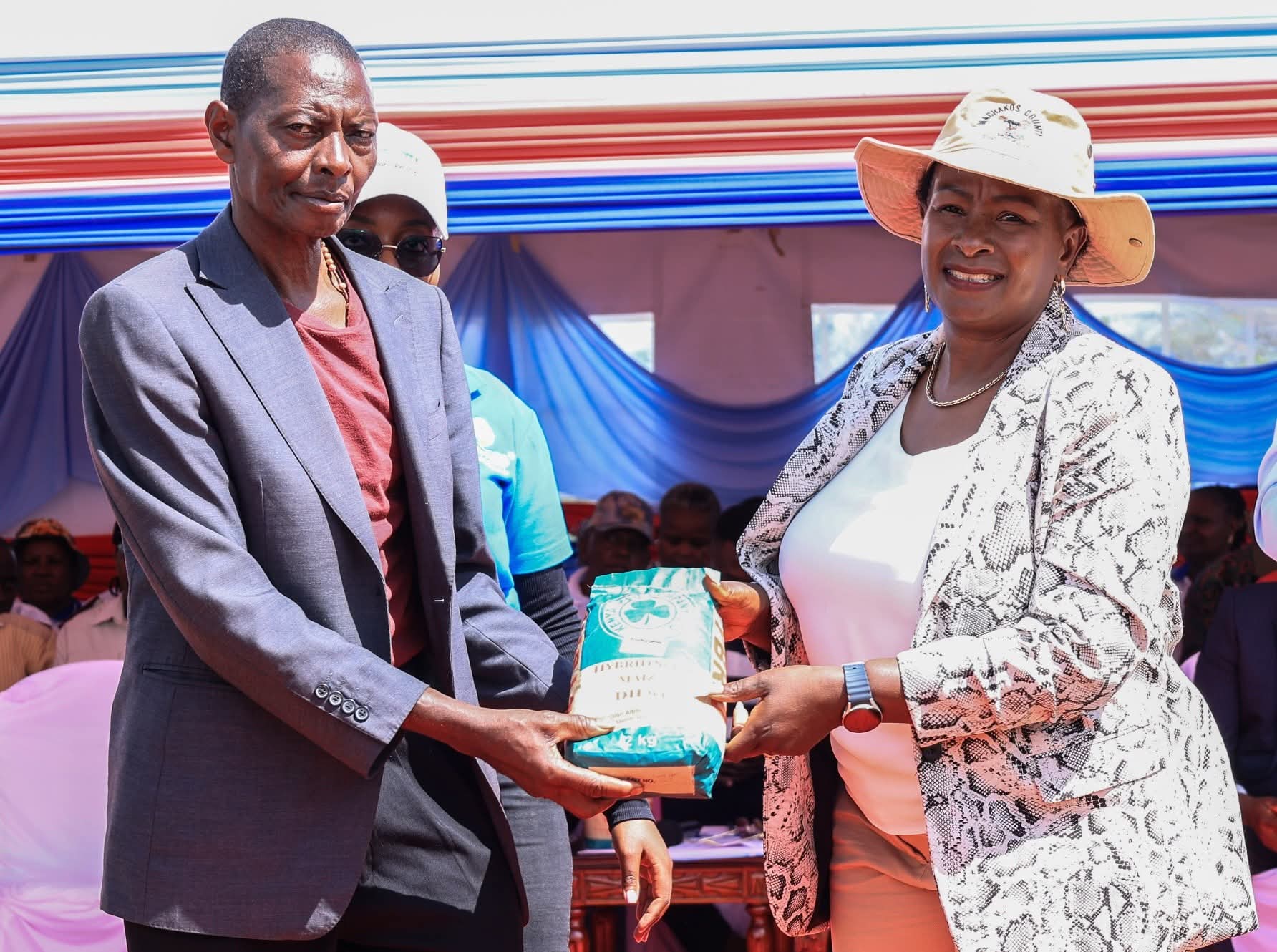
 Machakos Governor Wavinya Ndeti and a resident of Kathaana in Kangundo during the Official launch of the County seed distribution. Photo by Gvrns Press.


By Stanley Mumo
The Machakos County Government has rolled out 74.9 tonnes of certified seeds to 37,450 farmers in a renewed push to strengthen household food security ahead of the long rains season.
The seeds, now planted across 7,493 acres, are projected to yield 93,862 bags of grain — a harvest officials say will significantly boost food availability and incomes for families reliant on agriculture.
Speaking during the distribution exercise at Kathaana, Governor Wavinya Ndeti said the programme reflects her administration’s commitment to ensuring sustainable livelihoods for residents. She reiterated the county’s development agenda anchored on the rallying call, “Chakula Mezani, Pesa Mfukoni” — food on the table and money in the pocket.
County officials said the distribution was informed by prior mapping of soil types and rainfall patterns across different agro-ecological zones.
Maize and beans were allocated to higher rainfall areas, while drought-tolerant crops such as cowpeas and pigeon peas were directed to drier regions. The seeds supplied are certified, high-yielding, pest-resistant and climate-smart varieties designed to improve productivity under changing weather conditions.
Governor Wavinya directed that all beneficiaries receive their allocations within 48 hours to prevent delays that could compromise planting timelines.
Beyond seed distribution, the county has registered 200,000 farmers for subsidized fertilizer. In addition, 39 extension officers have been deployed at ward level to provide technical support and strengthen farmer outreach services.
The administration says decentralizing extension services will ensure farmers receive timely guidance on modern farming techniques, crop management and post-harvest practices.
In a parallel intervention targeting livestock farmers, the cost of Artificial Insemination services has been reduced from Sh3,000 to Sh200. The subsidy is expected to improve herd quality, increase milk production and raise household incomes for families dependent on dairy farming.
County officials project that the intervention will accelerate access to improved breeds previously out of reach for many small-scale farmers.
The Governor also urged residents to adopt sustainable land management practices, including tree planting, grass cultivation for livestock, and terracing to conserve water and prevent soil erosion.
The county maintains that the integrated approach — combining quality inputs, technical support and livestock improvement — is aimed at building long-term resilience and safeguarding future harvests.