


By Andrew Mbuva.
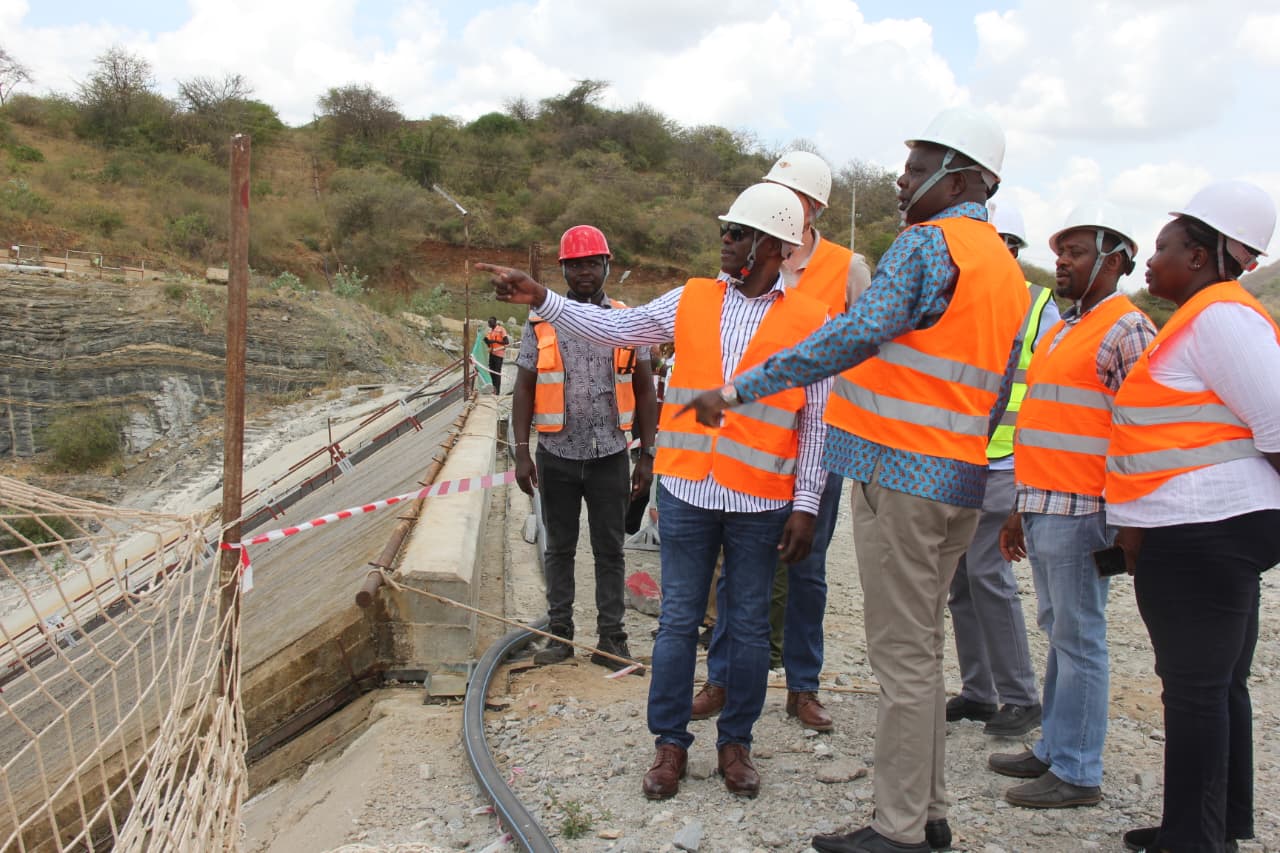
The Executive Director of the African Development Bank, Ronald Justin Cafrine, on Friday led a high-level delegation on a Phase One site visit of the Thwake Dam, as government officials expressed optimism that additional funding will soon unlock completion of the multi-billion-shilling project.
Speaking during the visit, Engineer Samuel Alima, the Water Secretary and Project Engineer, said construction of the dam, which began in March 2019, has reached 94.2 per cent completion.
“We are progressing well. However, at about 94 per cent, we introduced minor but necessary changes, including increasing the height of the dam from 77.3 metres to 80.5 metres to enhance storage capacity after realizing the site could hold more water,” said Eng. Alima.
He explained that engineers also encountered a weak foundation during construction, forcing them to excavate up to seven metres deep across a 50-metre width — an adjustment that significantly affected the project cost.
“These variations impacted the overall budget, which is why we are engaging the African Development Bank to assess the progress and explore additional resources to complete the remaining works,” he said.
According to Eng. Alima, the works pending include the concrete face of the dam, construction of a bridge over the spillway, and completion of the road linking Kitui and Makueni counties. With adequate funding and proper planning, he noted, the remaining works could be finalized within seven to eight months.
He expressed confidence that the AfDB Board will approve the additional financing by March, paving the way for completion.
Once finalized, the dam is expected to begin filling during the October–December short rains, with full impoundment projected during the following year’s long rains.
Upon completion, Thwake Dam will become the third largest dam in Kenya after Turkwel Dam and Masinga Dam, with a storage capacity of approximately 8,688 million cubic metres of water.
Beyond water storage, the project is structured in phases. Phase One covers construction of the dam, while subsequent phases will include water supply, hydroelectric power generation, and irrigation.
“We have started discussions with AfDB on downstream works, particularly water supply and power generation. Irrigation will largely rely on gravity and is technically simpler. If sufficient resources are secured, we can implement water, power and irrigation concurrently so residents of Makueni and Kitui can begin benefiting sooner,” Eng. Alima said.
The project is expected to supply water to Konza City, support sewerage systems in Kibwezi, and enhance water access for communities across Makueni, Kitui, Machakos and Kajiado counties.
“This is a game changer for the region. It will create a large reservoir that will transform livelihoods through irrigation, clean water supply and power generation,” he added.
However, Daniel Maanzo, the Senator for Makueni County, expressed concern over delays that have stalled the dam’s full realization.
“The people of Makueni urgently need water for domestic use, irrigation, sewerage systems in Wote town, and for the development of Konza City. This matter has been raised in Parliament before, and I will continue pushing for answers on when the project will be completed,” said Maanzo.
He criticized what he termed as slow progress over the past three years, saying residents have waited too long for the transformative benefits promised by the project.
The Senator also called for accelerated implementation of the power generation component, noting that communities around the dam still rely on diesel generators and lack connection to the national grid.
“It is ironic that we are spending huge sums to generate electricity at the dam, yet the surrounding communities remain without reliable power. The electricity project must prioritize this area,” he said.
Maanzo further urged the government to complete stalled complementary works, including engineers’ housing, which is critical for round-the-clock monitoring of the dam, and the tarmacking of the road connecting Kitui and Wote. He noted that the dam will also serve as a vital bridge across a river stretch spanning hundreds of kilometres without crossing points between Kitui, Makueni and Machakos counties.
While commending engineers for safely managing excess water during recent floods, preventing structural damage to the dam, the Senator emphasized the need for sustained government commitment.
“They need funding. They need seriousness in development so that this project is not delayed any further. The people are waiting,” he said.
With the AfDB now assessing the progress and financing needs, leaders and residents alike are hopeful that renewed financial backing will fast-track completion of what is widely viewed as one of Kenya’s most transformative water infrastructure projects.