
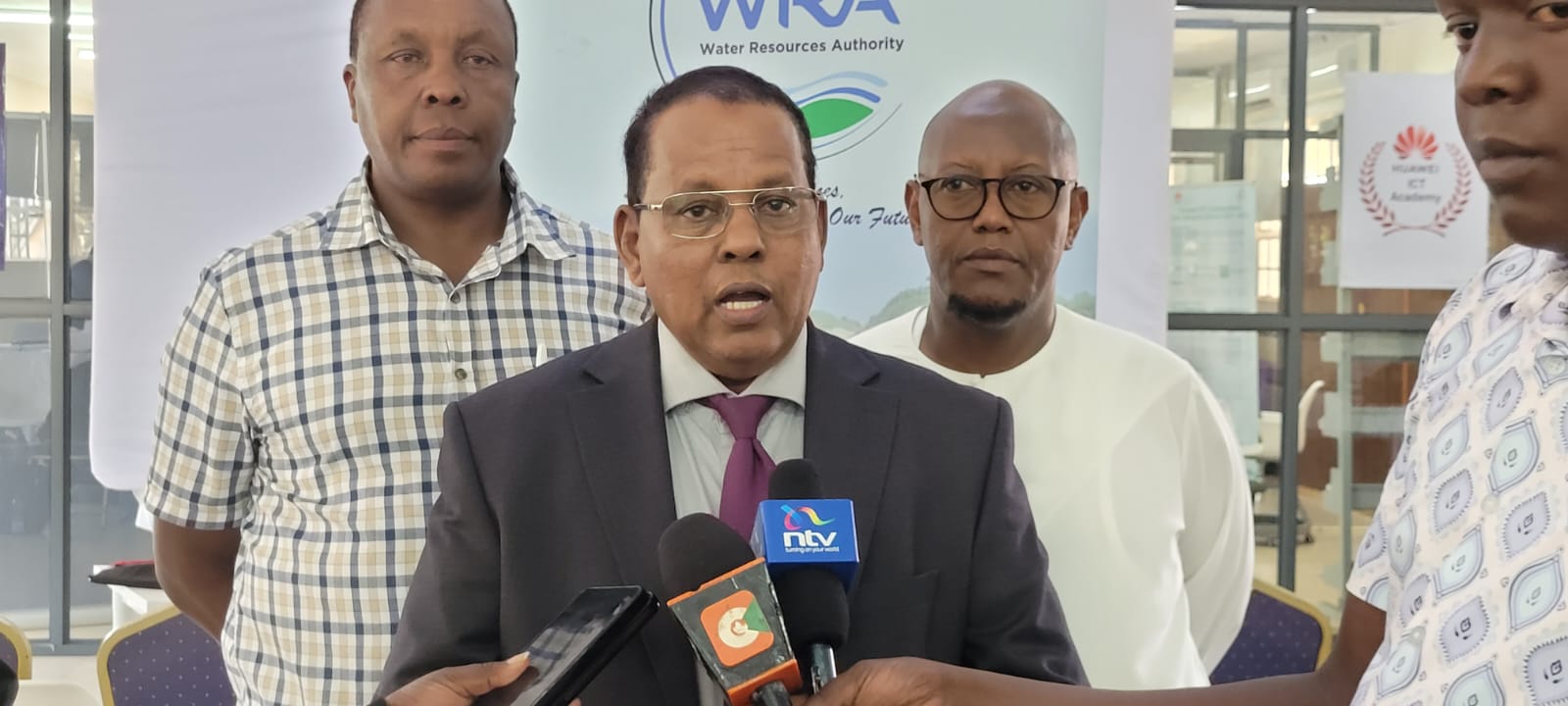
 WRA Chief Executive Officer Mohammed Shurie addressing the Media in Machakos after a public participation forum in Machakos on the Draft Water Allocation Guidelines and Thresholds on February 13, 2026. Photo by Virginia Siebella.


By Andrew Mbuva.
The Water Resources Authority (WRA) has launched a nationwide campaign to regulate water use and curb the proliferation of illegal boreholes, unveiling a new mobile application that allows citizens to apply for permits, make payments, and comply with water regulations from their homes.
Speaking during a public participation forum in Machakos on the Draft Water Allocation Guidelines and Thresholds, WRA Chief Executive Officer Mohammed Shurie stressed that while water is available, its management remains critical, especially amid recurring droughts.
“By law, not everyone is allowed to drill a borehole,” Shurie said. “Some areas are already gazetted and served by water providers. Anyone wishing to drill a borehole in these areas must obtain a no-objection from the service provider. Where water supply is insufficient, WRA can authorize borehole drilling.”
Shurie revealed that many Kenyans continue to drill boreholes illegally, but assured that the authority is identifying and dealing with offenders. “We are asking all Kenyans to stop drilling boreholes without our knowledge. Compliance is free, and we are ready to support anyone who follows the law,” he noted.
The CEO also highlighted ongoing efforts to address drought conditions. “During droughts, we ration water, even from private boreholes, to ensure fair distribution upstream and downstream. The government’s plan to construct over 100 mega water dams across the country will also improve per capita water availability, currently at just 500 cubic meters per person per year,” he explained.
WRA Chairperson Donald Murgor emphasized the importance of digitization in water management. “Water is central to every sector of the economy—health, agriculture, industry. Our role as a regulator is to ensure fair distribution now and for future generations. These guidelines will help us manage water efficiently and guarantee access to all Kenyans,” he said.
Representing water users, Ngotho George, coordinator of the Kiambu Community Water Projects Association, welcomed the initiative but urged WRA to consider waivers or moratoriums on backdated charges. “Many boreholes have existed since colonial times. Accumulated charges make compliance prohibitive. A clear moratorium will allow every Kenyan to declare water use and comply with the law going forward,” he said.
George underscored the communal nature of water resources, noting, “Water is a shared resource. If it is finite, we must ensure equitable access so that one user does not compromise the needs of another.”
The forum in Machakos marks a major step by WRA to engage citizens on water management, highlighting both technological innovation and regulatory enforcement to protect Kenya’s most vital resource.