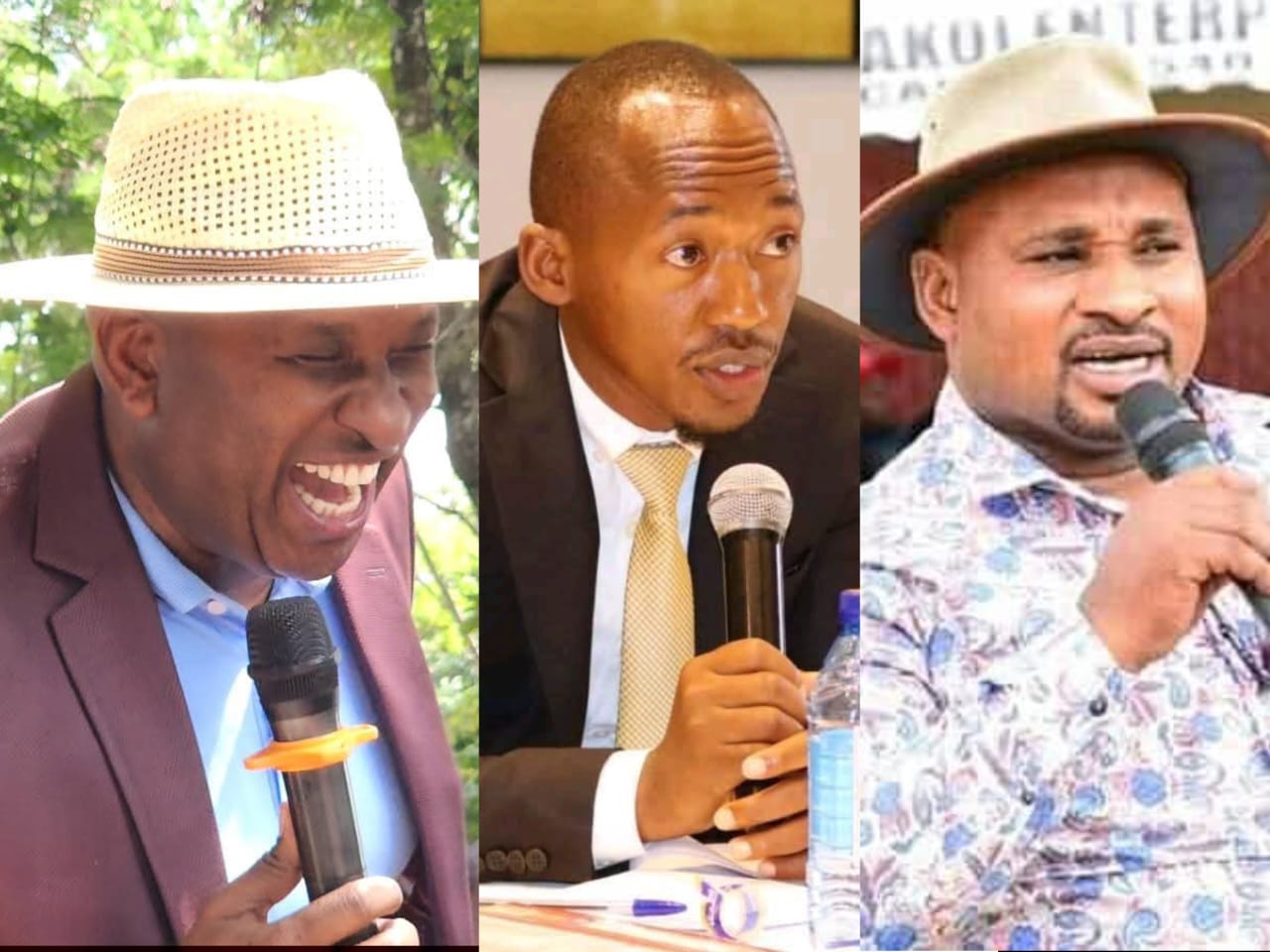
 From Left: Nairobi County Public Service Board Chair Thomas Kasoa, Mwala MP Vincent Musyoka and Businessman Barclay Kilei Mutinda. Photo by Andrew Mbuva.


By Andrew Mbuva.
The Mwala parliamentary race is steadily taking shape as one of the most intriguing political contests in Machakos County, defined by a powerful incumbent, experienced challengers battling for relevance, and the emergence of a youthful voice seeking to disrupt the status quo.
At the heart of the contest are four candidates whose political histories, ambitions and narratives reflect the broader dynamics of contemporary politics in Ukambani.
Voter numbers from the last General Election show that Mwala Constituency has no single dominant ward, making the contest largely dependent on coalition-building across the six wards. Masii leads with 18,523 registered voters, followed closely by Mwala with 17,815. Mbiuni has 16,671 voters, Wamunyu 13,959, Muthetheni 10,903 and Kibauni 9,976. This distribution means that while home-ward advantage matters, no candidate can win without appealing beyond their traditional base.
The man everyone is chasing is the incumbent MP, Vincent Musyoka. Now serving his third term, Vincent has built a political brand that appears largely immune to party tides. Having won the seat under three different parties—CCU, Maendeleo Chap Chap and now UDA—he has consistently argued that party politics no longer drive voter decisions in Mwala.
“To me, Wiper has never been a threat. I have beaten Wiper candidates in three consecutive elections,” he says. “Party politics is long gone. People nowadays look at the ability of a leader and accountability.”
Vincent’s electoral dominance is not in doubt. In all three elections, he has won by margins exceeding 60 per cent, with his strongest showing coming in 2022 when he secured 68 per cent of the vote.
His nickname, Kawaya, has become symbolic of his political philosophy. “Kawaya kala katheke niko kovaa ila mbimbu,” he often quips, loosely translated as, the thin wire is the one used to tie the thick ones. To his supporters, it reflects quiet strength and strategic thinking; to his opponents, it underscores his political resilience.
Beyond numbers, Vincent’s growing national profile has further strengthened his hand. As the UDA National Organising Secretary, he enjoys close proximity to President William Ruto and has leveraged this relationship to push development projects in Mwala.
He frequently points to tangible infrastructure gains as evidence of performance. “This term alone, we have improved electricity connectivity, initiated major road projects like Kivandini–Miseleni and Kangundo–Mwala which are now being tarmacked, and the Mwala Cluster Water Project worth KSh 1.5 billion is now 70 per cent complete,” he says.
Vincent dismisses claims that sharing a ward with one of his challengers could weaken him. “I have heard people say that Kasoa coming from my ward is a disadvantage,” he notes. “But last election I faced an opponent from my own ward, Ngengele, and my numbers were not affected at all.”
He remains confident that his support base is intact, adding that opposition votes are likely to be split. “Unlike before when the Wiper candidate could get 28 or 30 per cent, this time that vote will be shared between Kasoa and Kilei.”
Barcley Mutinda Kilei, a Wiper Party stalwart, is one of those hoping to chip away at Vincent’s dominance. Kilei is no stranger to Mwala politics, having served as CDF Chairman between 2007 and 2013 during the tenure of former MP Daniel Muoki. He supported Muoki’s re-election bids in 2013 and 2017, both of which ended in defeat to Vincent. In 2022, Kilei himself contested the seat under Wiper, managing about 17,000 votes against Vincent’s 38,000.
Despite the loss, Kilei has declared his intention to have another stab at the seat under the same party. His home base in Wamunyu Ward, the constituency’s fourth-largest in voter numbers, remains his key anchor. However, critics argue that his repeated attempts without success suggest limited room for growth. His detractors have nicknamed him Masinota, a jab at his distinctive high-waist dressing style, which they use to portray him as an old-school politician in a rapidly changing political environment.
The other major challenger, Thomas Mweu Kasoa, presents himself as both experienced and forward-looking. Kasoa served as a councillor for Mbiuni Ward from 2007 to 2013 and later as an MCA and Minority Leader in the Machakos County Assembly until 2017. He lost his re-election bid that year but has since resurfaced in national administration as the Chair of the Nairobi County Public Service Board.
“I have been a councillor for five years and an MCA for another five years,” Kasoa says. “I believe I have the experience required to lead the people of Mwala.” He often points to his current role overseeing a workforce of thousands in Nairobi as proof of his administrative capacity. “If I can manage such a large workforce, I don’t think I will have a problem leading Mwala.”
Kasoa has also drawn a clear line against Kilei within Wiper, arguing that the party must rethink its strategy. “Kilei has been given the Wiper ticket before and failed to deliver,” he says. “I don’t think the party can afford to make the same mistake again.” His campaign leans heavily on the change narrative, insisting that Mwala is ready for new leadership after 15 years under one MP. “The people want fresh blood,” he insists.
Economic empowerment, particularly for the youth, is central to Kasoa’s message. He claims that during his tenure at the Nairobi County Public Service Board, more than 300 people from Mwala have been employed. He has also floated the idea of establishing a fruit processing factory in the constituency. “I want to be the first MP to do a fruit factory in Mwala,” he says. “This will help our farmers avoid post-harvest losses of mangoes, oranges and other fruits.”
Kasoa’s political calculations are complicated by the fact that he comes from Mbiuni Ward—the same ward as Vincent—raising the possibility of vote splitting at the local level. His nickname, Ndumbîa, derived from his oft-repeated phrase about holding a “hidden card,” adds an element of suspense but also invites scrutiny over what that card actually is.
Adding a different dimension to the race is Dennis Mumo, a first-time aspirant and outspoken critic of the current administration. Mumo positions himself as the voice of the younger generation, tapping into Gen Z frustrations around accountability, opportunity and political renewal. While he lacks the machinery and experience of his rivals, his candidacy reflects a growing appetite among young voters to challenge long-standing political hierarchies.
Taken together, the Mwala parliamentary race is less about party dominance and more about personal credibility, development records and voter perception. While Wiper remains the most popular party in Ukambani, the fact that the sitting MP and all six MCAs in Mwala are not from Wiper underscores a political reality that cannot be ignored.
For now, Vincent Musyoka’s incumbency, development track record and fractured opposition give him a clear edge. Yet, as history has shown, politics remains fluid—and in Mwala, the final verdict will rest with how convincingly each candidate connects performance, promise and trust.