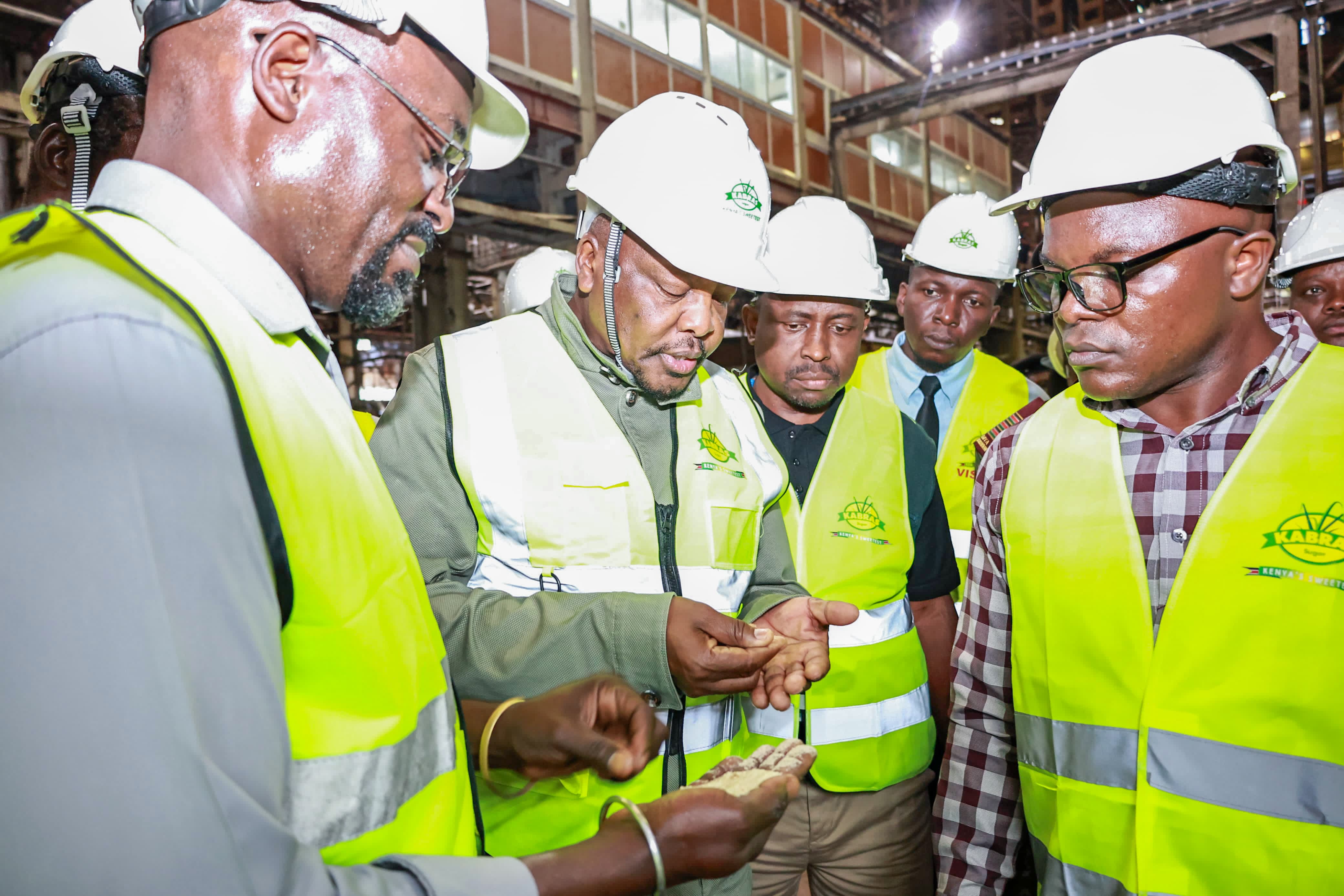
 Kenya Sugar Board CEO Jude Chesire joined CS Agriculture Mutahi Kagwe during a visit to West Kenya Sugar Company in Kakamega. Photo Courtesy.


By Andrew Mbuva.
Kenya has formally exited the COMESA Sugar Safeguard regime after 24 years, marking a major milestone in the transformation of the country’s sugar industry and signaling confidence in its ability to compete within the regional market.
The safeguard, which lapsed on November 30, 2025, had been in place since the launch of the COMESA Free Trade Area in 2001 to allow Kenya’s sugar sector time to stabilize, restructure, and undertake critical reforms.
According to the Kenya Sugar Board, the objectives of the safeguard have now been fully achieved, paving the way for a new phase anchored on competitiveness, value addition, and sustainability .
Government officials insist that the exit reflects strength rather than vulnerability. The sugar industry, they say, is now stable, better managed, and supported by clear policy direction. Farmers, millers, workers, and investors have been assured that the transition will not expose the sector to disruption but will instead open opportunities within a structured and fair regional trading environment .
Over recent years, policy focus has deliberately shifted from protectionism to competitiveness. The Kenya Sugar Board, under the Ministry of Agriculture and Livestock Development, has championed value addition, efficiency, and diversification as key pillars of reform.
Sugarcane is increasingly treated as an industrial raw material rather than just a source of table sugar, with millers investing in ethanol production from molasses, electricity generation from bagasse, paper and board manufacturing, and industrial alcohols. These integrated processes have strengthened miller balance sheets, stabilized cash flows, and improved payments to farmers .
The reforms have coincided with a strong recovery in production. Sugarcane acreage expanded by 19.4 per cent, from 242,508 hectares to 289,631 hectares, supported by favorable rainfall, improved access to certified seed cane, and fertilizer subsidy programs. As a result, national sugar production rose by 76 per cent, from 472,773 metric tonnes in 2022 to 815,454 metric tonnes currently, reflecting gains in both farm productivity and factory efficiency .
Kenya’s annual sugar demand stands at about 1.1 million metric tonnes. While domestic production has significantly improved, the government acknowledges that capacity expansion, factory rehabilitation, and optimization of newly leased mills will take time.
To bridge the gap, Kenya will continue to supplement local supply through controlled imports from both COMESA and other approved sources to ensure price stability, food security, and market certainty without undermining local producers .
The sugar sector remains sensitive to climatic conditions, with expected dry spells likely to affect short-term output. However, periods of adequate rainfall are projected to significantly boost production, dynamics that have been factored into ongoing planning and market coordination measures.
In the medium term, the outlook is optimistic. As miller capacity expands and farm productivity improves, Kenya is projected to achieve and surpass self-sufficiency, positioning the country for surplus production and regional export competitiveness.
The exit from the COMESA safeguard also aligns with deeper structural reforms, including the transition of former state-owned sugar mills to long-term private leasing. The leasing framework was designed to restore efficiency, professionalism, and accountability while giving investors sufficient time to stabilize operations and realize returns under predictable policy and trade arrangements .
Kenya Sugar Board Chief Executive Officer Jude Chesire said the conclusion of the safeguard marks the successful completion of a reform cycle, not its abandonment.
He reaffirmed the government’s commitment to protecting farmer livelihoods, supporting miller viability, and ensuring food security, price stability, and long-term growth of the sugar sector within the COMESA Free Trade Area .