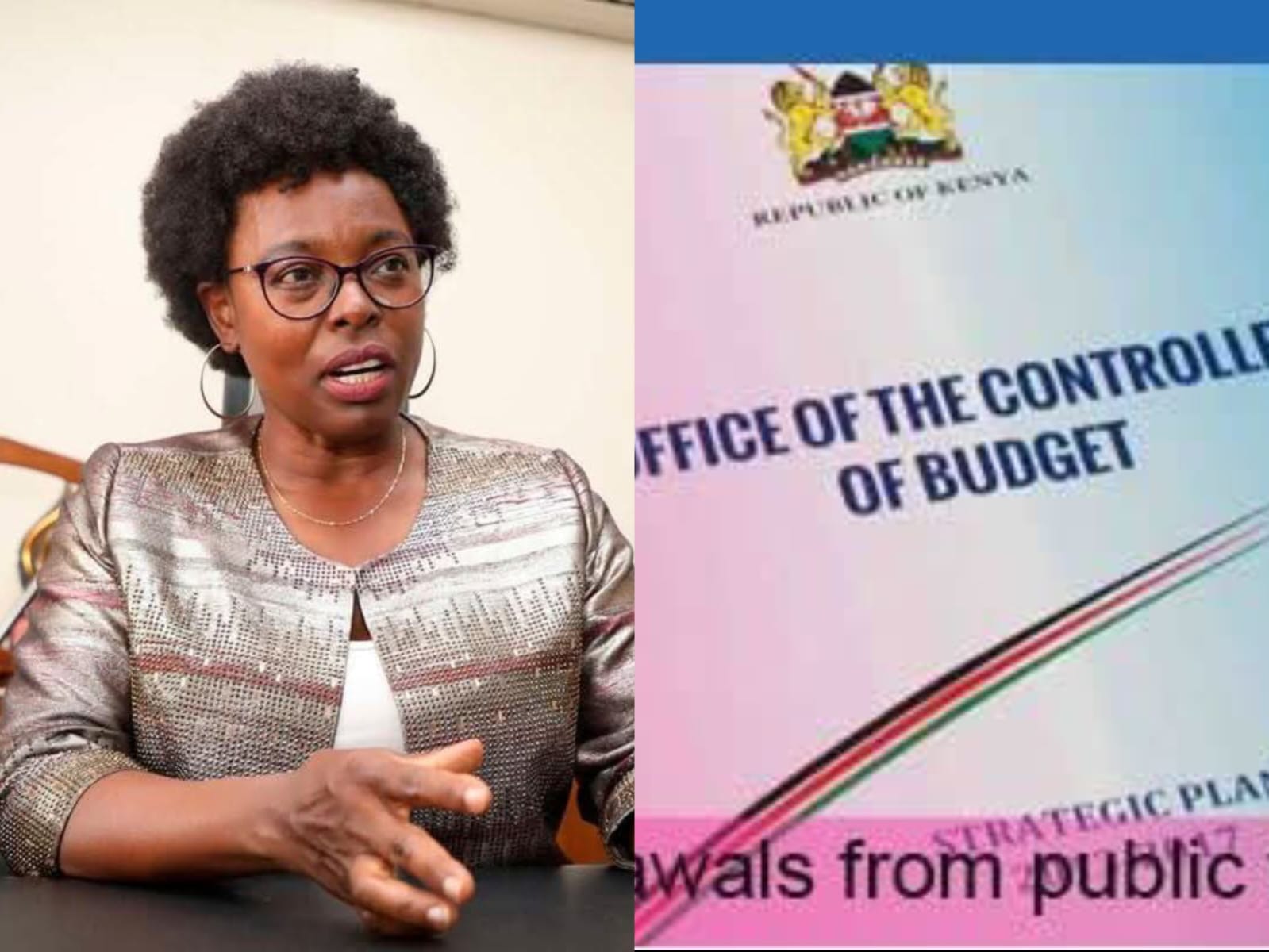
 Controller of Budget Dr Margaret Nyakang’o. File Photo.


By Andrew Mbuva
Kenya’s 47 county governments are grappling with slow budget absorption, ballooning pending bills and weak development spending, according to the latest County Governments Budget Implementation Review Report by the Controller of Budget (CoB) .
The report, which reviews the first quarter of the 2025/26 financial year (July–September 2025), shows that counties spent only KSh55.15 billion—just 9 per cent of their combined annual budgets—despite having access to over KSh107 billion during the period. Of this expenditure, a staggering 93 per cent went to recurrent costs, leaving development projects severely underfunded .
According to the CoB, counties collectively approved budgets worth KSh603.72 billion for the current financial year, with KSh217.8 billion earmarked for development and KSh385.92 billion for recurrent expenditure. While the development allocation met the legal threshold of at least 30 per cent, actual spending on development told a different story. Only KSh3.69 billion was spent on development activities in the first quarter—equivalent to a paltry 2 per cent absorption rate, down from 3 per cent over a similar period last year .
The slow uptake of development funds has raised concerns about stalled projects and delayed service delivery across the counties. Twenty counties, including Turkana, Kilifi, Kisumu, Mombasa and Bungoma, reported zero development expenditure during the review period .
Revenue performance also remained shaky. Counties collected KSh13.94 billion from own-source revenue (OSR), representing just 15 per cent of the annual target of KSh93.89 billion. While this marked a modest improvement compared to the same period last year, several counties performed poorly, with Kericho collecting only 4 per cent of its target and Siaya 6 per cent. Samburu led in OSR performance, having achieved 40 per cent of its annual target within the first quarter .
At the same time, revenue arrears continued to choke county finances. Outstanding arrears stood at KSh156.23 billion by the end of September 2025, including KSh113.9 billion in unpaid own-source revenue and KSh35.28 billion related to delayed equitable share transfers .
The report further paints a grim picture of counties’ debt burden, with pending bills—now referred to as trade payables—soaring to KSh177.47 billion. Nairobi City County alone accounted for KSh82.89 billion of this amount, followed by Kilifi (KSh9.7 billion), Kiambu (KSh6.47 billion) and Machakos (KSh5.8 billion) .
Controller of Budget Dr Margaret Nyakang’o attributed the poor performance to delayed disbursement of funds by the National Treasury, late submission of budget documents by counties, weak own-source revenue collection and overreliance on Facility Improvement Financing, particularly in the health sector .
She urged Parliament to fast-track the enactment of the County Governments Additional Allocations Act and called on the National Treasury to adhere strictly to monthly disbursement schedules. Counties, on their part, were advised to prioritise clearing pending bills, boost revenue collection, accelerate development spending and comply with reporting requirements .
“The current trends, if left unaddressed, risk undermining service delivery and slowing down county-level development,” the CoB warned, calling for urgent corrective measures to ensure public funds translate into tangible benefits for citizens.