


By Andrew Mbuva.
Communities living around the multi-billion-shilling Thwake Dam project on the border of Kitui and Makueni counties have accused the Chinese contractor implementing the project of conducting a flawed and opaque compensation exercise for homes damaged by blasting activities.
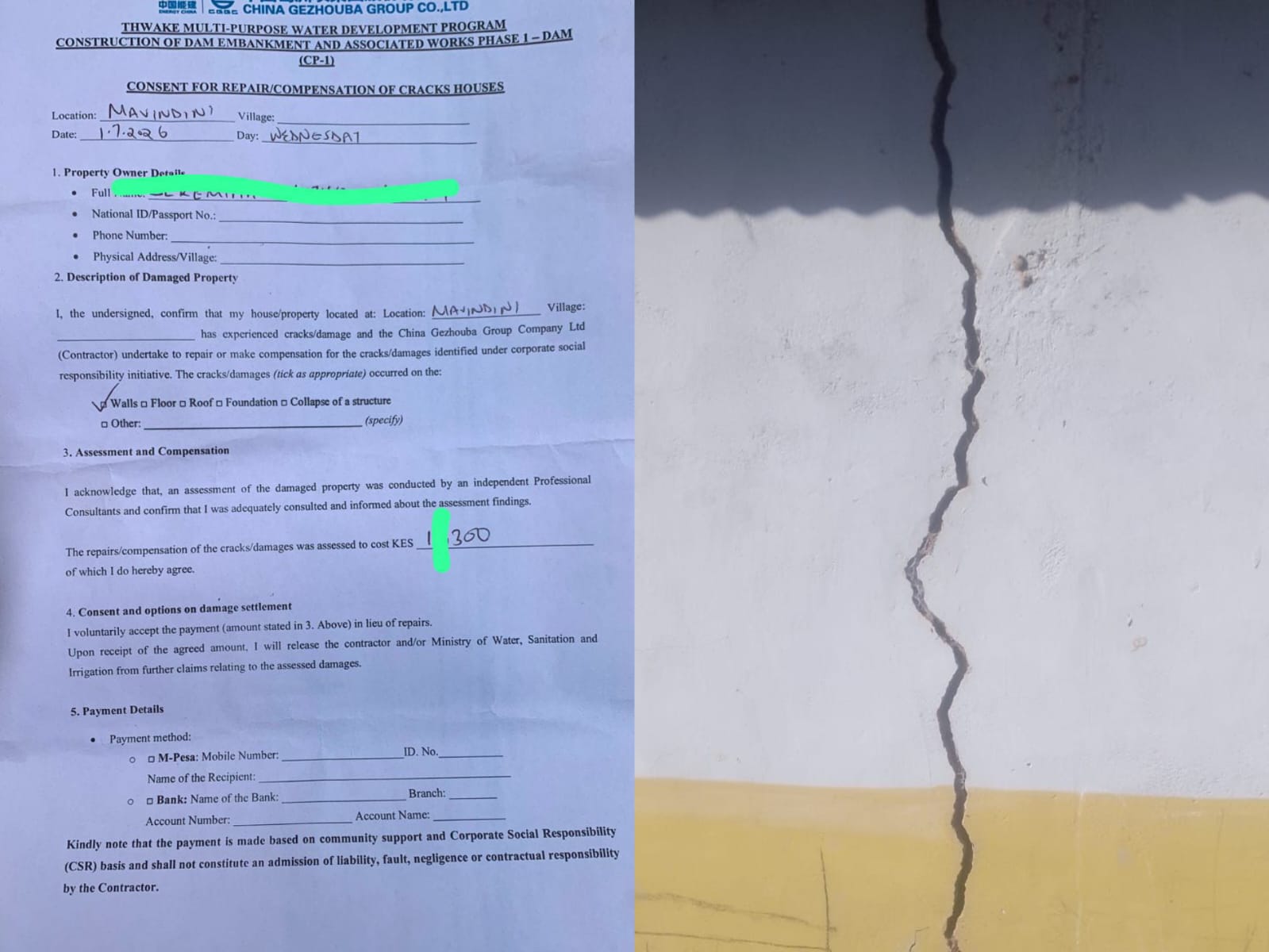
The residents claim that explosives used to break rocks during the construction of the dam caused severe cracks in their houses, forcing some families to abandon their homes for safety reasons. However, they now allege that the compensation process has been marred by favoritism, lack of transparency and exclusion of many deserving victims.
The affected families have particularly faulted China Gezhouba Group Company Limited, the contractor undertaking the project, for offering what they describe as "peanuts" to some victims while allegedly awarding significantly higher amounts to others under unclear circumstances.
SooTV has established that beneficiaries who were selected for compensation were required to sign forms indicating that the payments were being made as a goodwill gesture by the contractor aimed at maintaining a good relationship with the surrounding community.
One of the affected residents, Nicholas Nzioka from Ilumani A village in Mavindini Location, said his family's life was turned upside down after repeated blasting left two of his houses cracked and destroyed his pit latrine.
"There was a time when they were using explosives to break rocks at the Thwake Dam site. The blasts cracked two of my houses and my toilet collapsed completely. My wife was pregnant at the time and we were forced to move to Wote because it was no longer safe to stay in our home," said Mr Nzioka.
He said residents had initially been assured that experts would later assess every damaged property before compensation was paid.
However, according to him, the exercise was conducted selectively.
"When the assessment team finally came, not everyone was visited. The chief, who chaired the committee, only identified a few people he knew or those close to him. Many poor families who had genuinely suffered were completely left out," he claimed.
Mr Nzioka further alleged that residents were never shown any assessment report indicating the extent of damage to their homes or the basis upon which compensation amounts were determined.
"People were simply called one by one and told to sign documents so that the Thwake Dam project could continue. After signing, someone would write an amount using a pen. Some received Sh3,000, others Sh5,000, some slightly above Sh10,000, while others allegedly received millions depending on who they knew," he alleged.
He accused the committee overseeing the exercise of lacking community representation, saying it comprised chiefs from Kitui and Makueni together with contractors but excluded representatives from affected villages such as Mavindini and Kathulumbi.
"We want this entire process stopped until a fair solution is reached. Every affected person, whether rich or poor, deserves equal treatment. We also want to know how the list of beneficiaries was prepared and who forwarded those names to the Ministry of Water," he said.
The controversy has also drawn criticism from local leaders.
Mavindini MCA Jonathan Kimongo said elected leaders were completely excluded from the compensation exercise despite representing the affected communities.
"As leaders, we were never involved in identifying or compensating the affected residents. It is shocking that such an important exercise could be undertaken without involving us," said Mr Kimongo.
He called for the entire exercise to be suspended and restarted from scratch.
"We have demanded that everything be stopped and the process begins afresh starting with a proper assessment. There must be clear parameters indicating which homes qualify depending on their proximity to the dam, whether it is one kilometre or five kilometres away," he said.
The MCA further called for consultations involving the contractor, the government and all relevant stakeholders before compensation resumes.
"We need a lasting solution agreed upon by the contractor, the government and all stakeholders. Important offices such as those of the Deputy County Commissioner, Assistant County Commissioners, Members of Parliament, MCAs and local administrators must all be involved," he said.
Mr Kimongo claimed preliminary findings suggested that only chiefs and assistant chiefs were aware of the compensation process while other government offices remained in the dark.
"It appears some people deliberately kept other leaders away so that our people could be shortchanged. This time, every institution must be involved to guarantee fairness and transparency," he added.
The residents are now demanding a fresh, transparent assessment of all damaged properties and a review of the compensation process, insisting that no family affected by the dam construction should be left behind.