


By Andrew Mbuva.
Wiper Party leader Stephen Kalonzo Musyoka has launched a scathing attack on the Government’s proposed 2026/2027 Budget and Finance Bill 2026, describing them as a “cruel” blueprint that burdens ordinary Kenyans with debt, taxes and underfunded essential services while neglecting the country’s most pressing social needs.
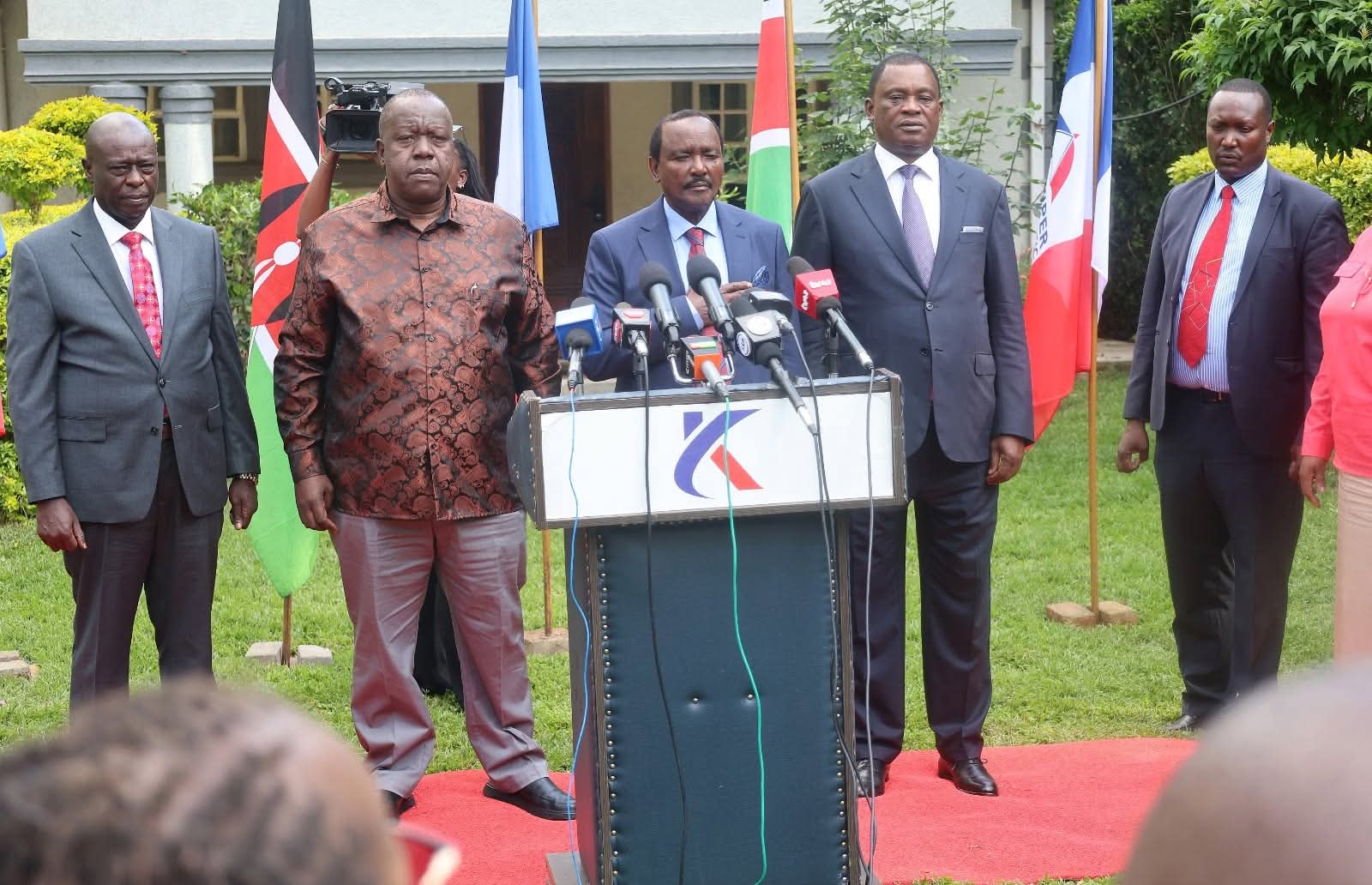
Speaking on behalf of the United Alternative Government, Kalonzo unveiled what he termed a fully costed “People’s Budget”, positioning it as an alternative economic roadmap focused on education, healthcare, job creation and reducing the cost of living.
Addressing the nation on Wednesday, Kalonzo accused President William Ruto’s administration of prioritizing debt repayments and bureaucracy over the welfare of citizens, arguing that the budget exposes millions of Kenyans to economic hardship.
“Nothing in all my years of public life has prepared me for the cruelty of this budget. It is not just incompetence and miscalculation, but cruelty,” Kalonzo said.
According to Kalonzo, the Government’s proposed KSh4.82 trillion expenditure plan far exceeds projected revenues of KSh3.63 trillion, leaving a fiscal deficit of KSh1.11 trillion that will be financed through borrowing.
He argued that the country’s growing debt burden is unsustainable, noting that KSh1.5 trillion of the budget has been earmarked for debt obligations and pensions, with interest payments alone standing at KSh1.25 trillion.
“To put that in language every Kenyan understands, interest on domestic debt alone costs more than the entire education budget. We are spending more on paying bankers than on teaching children,” he said.
Kalonzo reserved some of his strongest criticism for the education sector, claiming that despite constitutional guarantees of free and compulsory basic education, the Government has failed to adequately fund schools.
He cited a KSh28.4 billion shortfall in Free Day Secondary Education capitation and an KSh18 billion gap in Free Primary Education funding, warning that the deficits are forcing schools to pass costs to parents.
“Free means free. All the way from Class One to Form Four for every Kenyan child,” he declared.
The former Vice President also linked recent unrest and tragic fire incidents in schools to inadequate investment in student welfare and safety infrastructure. He called for a nationwide audit of boarding school dormitories and the introduction of a fully funded national school mental health programme.
On healthcare, Kalonzo criticized the implementation of the Social Health Authority (SHA), describing it as “mandatory taxation disguised as healthcare reform.”
He claimed the health system remains underfunded despite mandatory deductions from workers and questioned the value of a reported KSh104 billion technology contract linked to SHA.
“SHA, in its current form, is not a health policy. It is a compulsory tax with a hospital logo,” he said.
Kalonzo further opposed provisions in the Finance Bill 2026, including a proposed 16 percent Value Added Tax on mobile money transaction fees and a 25 percent excise duty on mobile phones at activation.
He warned that the measures would disproportionately affect low-income earners who rely heavily on digital financial services.
“The Government has found a way to tax the poor even when they are not buying anything. They are taxing the movement of money itself,” he said.
The opposition leader also raised concerns over reports that strategic national assets such as the Kenya Ports Authority and Government shares in Safaricom could be divested to address fiscal pressures.
“These are Kenya’s crown jewels. They belong to the people and should not be sold quietly without public participation and parliamentary approval,” he stated.
As part of the United Alternative Government’s proposed People’s Budget, Kalonzo pledged to reduce overall government spending by nearly KSh500 billion while increasing allocations to education and healthcare.
The proposal includes fully funding free education, reinstating programmes such as Linda Mama and Edu Afya, establishing an KSh80 billion National Youth Employment Compact, abolishing the Housing Levy, and removing proposed taxes on mobile money services and mobile phones.
He also proposed significant cuts to State House expenditure, the National Intelligence Service budget and other government administrative costs, arguing that the savings should be redirected to agriculture, irrigation and social services.
Kalonzo challenged Members of Parliament to reject what he described as punitive taxation and underfunding of critical services, warning that their decisions would be judged by voters in the next General Election.
“You were not elected to be a rubber stamp. History will record your vote, and the people will make their judgment at the ballot,” he said.
The Wiper leader concluded by portraying the People’s Budget as a citizen-centered alternative designed to restore public confidence in government and ease the economic burden facing households across the country.
“A budget is a declaration of values. Our administration will be built on the principle that in the Republic of Kenya, the government serves the people, not the other way around,” Kalonzo said.